Thinking about three-phase power for your Canberra home? Find out if you need it, what it costs, and how the upgrade works. Get a free assessment today.
Most Canberra homes run on single-phase power without issue. But there’s a point where single-phase starts working against you, and that point arrives faster than most people expect once you start adding ducted air conditioning, an EV charger, a home workshop, or a solar system with battery storage.
It’s a different way of delivering electricity into your home. For properties with serious energy demands, it’s often the most practical fix available.
This guide covers what three-phase power actually is, how to work out whether you need it, what the upgrade costs, and what to do if you’ve decided it’s the right move.
What Three-Phase Power Actually Is
Standard residential power in Australia is single-phase: one active wire, one neutral, delivering at 230 volts. Fine for most homes. The problem is capacity.
Three-phase uses three active conductors, each offset by 120 degrees. Power delivery is smoother, more consistent, and the voltage between phases hits 400 volts. A single-phase 32A circuit gives you roughly 7.4kW. The same circuit on three-phase delivers up to 22kW.
That gap is where most people’s problems live.
Air conditioning compressors, pool pumps, workshop machinery, heat pumps, they all run more smoothly on three-phase because the power delivery never drops to zero. Single-phase oscillates. Three-phase doesn’t. Over time, that means less wear on motors and, in many cases, lower running costs.
Do You Actually Need It?
It comes down to load. What are you running now, and what are you planning to add?
Single-phase is fine for the standard household. Lights, TVs, fridges, washing machines, a split-system, no problem. A typical single-phase connection maxes out around 63 amps, roughly 14kW continuous. That’s plenty for most homes.
The numbers shift fast once you start stacking. Ducted air conditioning alone can pull 6 to 10kW. Add an EV charger and a hot water system running at the same time, and you’re already past what single-phase can reliably handle.
Some scenarios where three-phase makes clear sense for Canberra properties:
You’re installing a 22kW EV charger and want full charging speed. Single-phase caps at 7.4kW regardless of which charger you install. The cable, not the charger, is the limit.
You’re running ducted reverse-cycle air conditioning across a larger home, particularly relevant in Canberra, where you’re running heavy heating in winter and heavy cooling in summer, sometimes back to back for months.
You have solar panels and are installing battery storage, and want to maximise what you can export and store without hitting single-phase export limits.
You’re setting up a home workshop running welders, lathes, or large dust extraction equipment built around three-phase motors that simply won’t perform properly on single-phase.
Your property already runs multiple high-draw appliances, and you’re experiencing regular circuit trips or voltage drop.
If none of those apply, single-phase is almost certainly fine. An EV charger on a single-phase 32A circuit delivers 7.4kW, which adds roughly 30 to 40km of range per hour of charging. For most daily commutes in Canberra, that’s enough overnight.
How to Tell If You Already Have Three-Phase Power
Worth checking before you spend anything. Some properties, newer builds, and homes in established suburbs close to commercial areas may already have a three-phase supply sitting at the street.
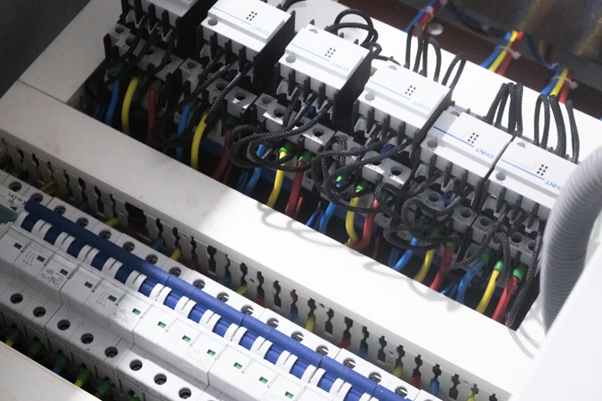
Go to your meter box and look at the main switch. A single-phase setup has one main switch. Three-phase typically has a main switch with three linked poles, or three separate main switches grouped together.
You can also look at the cable running from the street to your property. A single-phase connection has two conductors. A three-phase connection has four. If you can see four wires at your point of attachment, the infrastructure may already be there, and your switchboard might just need upgrading to take advantage of it.
If you’re unsure, an electrician can confirm quickly during any site visit. It’s one of the first things worth establishing because it significantly affects cost.
What the Upgrade Involves
Three-phase installation sits across two different scopes of work handled by two different parties: your network distributor (ActewAGL in the ACT) and your licensed electrician.
The distributor handles everything from the street to your property — the cables, any pole work, and the metering. Your electrician handles everything on your side: the switchboard, internal wiring, consumer mains, and circuit configuration.
The process typically runs in this order:
Your electrician visits, assesses the load, and submits a connection application to ActewAGL. It details your expected demand, switchboard location, and any site specifics.
ActewAGL processes it. Usually two to four weeks. They come back with a connection offer covering whatever infrastructure work is needed on the street.
You accept, pay, and the electrician upgrades the switchboard, new main switch, new consumer mains, and circuits balanced across the phases.
Network crew connects from the street. Brief outage, new cables energised, done on their end.
Meter goes in. Three-phase live.
Cost Breakdown
Straightforward properties, three-phase already at the street, switchboard in decent condition, typically land between $3,000 and $5,000 all in.
Once underground trenching enters the picture, or the network needs to run cables any real distance, it climbs. Complex jobs sit between $7,000 and $10,000. Some go higher.
The electrician’s portion — switchboard, consumer mains, labour, usually runs $2,500 to $4,500. Older Canberra homes often need a full switchboard replacement as part of it. Better to know that going in.
Running costs after the upgrade? Roughly the same. The daily supply charge can be marginally higher depending on your retail plan, but the per-kWh rate is identical. Workshop equipment with three-phase motors often runs more efficiently, which can offset this.
Three-Phase EV Charging: What Your Car Can Actually Accept
Fast EV charging is the most common reason people look at three-phase. There’s one thing worth checking first: your car’s onboard charger rating.
A 22kW home charger needs a three-phase supply. But your car charges at whatever speed its onboard charger allows, not whatever the wall unit is rated to. A 22kW charger does nothing extra if the car accepts 7kW.
BYD Atto 3: 7kW maximum. Hyundai Ioniq 5: 11kW. Porsche Taycan and BMW iX: the full 22kW.
Check your owner’s manual under charging specifications, or look at the sticker inside the charging port door. If you’re capped at 7.4kW, a single-phase 32A circuit gets you there at a fraction of the cost.
The future-proofing case is real, though. If your next vehicle has a higher-capacity onboard charger, or you’re eventually running two EVs, doing the infrastructure once as part of a single project makes more sense than coming back to it later.
Preparing for the Upgrade
A few things are worth having clear before calling anyone.
Know what you’re starting with. Check your meter box, one main switch means single-phase, three linked poles means three-phase. Look at the cable from the street. Four wires means the infrastructure may already be there, which changes the cost conversation significantly.
List everything that runs at the same time at peak. Air conditioning, EV charger, hot water, workshop equipment. That’s what drives the demand calculation.
Check your switchboard. Properties in Belconnen, Tuggeranong, North Canberra, a lot of those boards are old enough that replacement is part of the job, not an optional extra. Better to know upfront.
If you’re adding solar or batteries at the same time, flag it early. Larger generation systems have grid connection requirements that affect the design.
The Bottom Line
Three-phase power is worth upgrading to when your electrical load genuinely demands it. For homes adding 22kW EV charging, large ducted air conditioning systems, or serious workshop equipment, it’s often the practical solution that prevents ongoing problems. For homes that don’t have those demands, single-phase is more than enough.
The upgrade is straightforward when handled by a licensed electrician who knows the ActewAGL application process. The timeline from application to live connection typically runs four to six weeks. The result is a property that can handle modern energy demands without tripping, without voltage drop, and without the limitations that come from pushing a single-phase connection past its ceiling.
Contact Watts Needed to get your property assessed and a clear picture of what your upgrade would actually involve and cost.