If your neighbours’ lights are out too, the fault sits on the Evoenergy network, and Evoenergy will restore it. Report it on 13 10 93. If your street is lit and only your place is dark, the problem is on your side of the point of supply, which makes it a licensed electrician’s job and your cost.
That single distinction decides who you ring, how long you wait, and whether you pay for it. Most Evoenergy power outages in Canberra are network events with a clear cause and a published restoration estimate. A smaller number of calls we take during a blackout turn out to have nothing to do with the network at all.
Key takeaways
- Look outside before you call anyone. The 30-second check answers the question for free.
- What tripped matters more than the fact something tripped.
- Planned outages come with a letter and an SMS. No notice means unplanned.
- Repeat outages in the same pocket of a suburb are a network asset problem, not a switchboard problem.
How do I know if it’s an Evoenergy outage or my house?
Street lights on and neighbours lit up, and the problem is yours. Whole street dark, and it belongs to Evoenergy.
The check costs nothing and takes about half a minute, and almost nobody does it first. People call a sparky for a substation fault, or wait on Evoenergy when the house has no power for reasons the network can’t fix. Both waste an evening. Only one of them costs you a callout fee.
The dividing line is the point of supply, roughly where the service line from the street terminates at your property. Poles, street mains, substations and that service line are Evoenergy’s responsibility. Everything past it is yours, and yours to pay a licensed electrician to sort out.
Why did the power go out for no reason?
There’s almost always a reason; you just can’t see it from the kitchen. Vegetation across a line, a car into a pole, storm damage, or equipment failure at a zone substation.
Storms do most of the damage in the ACT. The July storms this year had crews working across Canberra with several thousand customers off at the peak, and events like that take hours rather than minutes because the damage is scattered across dozens of separate sites, each needing to be found, isolated and repaired.
Repeat outages are a different animal.
If your corner of the suburb goes dark four or five times a year while the rest of Canberra stays on, nothing inside your switchboard will change that. Older parts of Duffy have that reputation, and so do a few of the newer Gungahlin corridors where the network is carrying more load than it was designed for. Log the dates. Report every one, including the ten-minute ones nobody bothers with, because that reporting record is what eventually builds the case for Evoenergy to replace the asset causing them.
Planned work comes with notice. Evoenergy sends a physical letter, then an SMS, then a reminder SMS the day before. One detail that catches people out: the SMS goes to the primary account holder on the retail account, so tenants and anyone who isn’t the first name on the bill routinely get nothing. If no letter arrived and the lights are out, treat it as unplanned and call it in. There will be a fault reference.
Part of the house has no power and no breaker has tripped
A partial power outage with nothing tripped usually points to a failed connection upstream of the affected circuits, or to a lost phase in a multi-phase supply. Either way, it needs a licensed electrician.
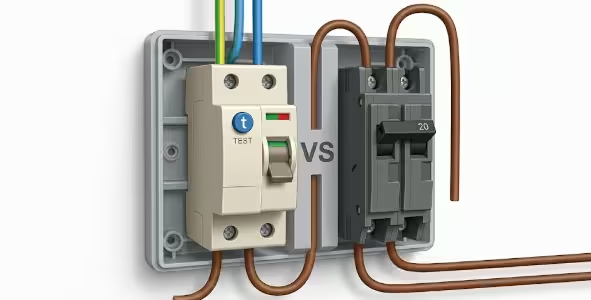
What tripped tells you more than the fact that something tripped. A single circuit breaker off means one circuit is overloaded or one appliance has given up, and a breaker that trips at the same time every evening is usually pointing at whatever you switch on at that hour. An RCD, the safety switch, generally means moisture or an appliance leaking current to earth, and after rain it’s usually the outdoor or bathroom circuit. The main switch off with every other device sitting up is a different conversation, and not a comfortable one.
Resetting the same breaker three times isn’t fixing anything. The device is doing precisely what it was installed under AS/NZS 3000 to do, which is disconnect a circuit that’s misbehaving. Keep forcing it back on and you’re overriding the one thing standing between a fault and a fire. Once, to see whether it holds, is fair enough. After that you’re guessing with the protection turned off.
Scorch marks around a breaker are the obvious warning. Less obvious: switches that sit warm under your hand, or a board that’s tripping more often this winter than it did last. None of that is an emergency at eight o’clock on a Tuesday night. All of it is worth a look.
How do I check for an Evoenergy outage in my area?
Evoenergy publishes a live outage map showing current unplanned and planned outages by suburb, and the faults line on 13 10 93 is staffed around the clock.
The map is least useful at the exact moment you want it most. When Gold Creek Zone Substation dropped out in May and took close to 37,000 Gungahlin customers with it, the website buckled under the number of people checking at once, and a fair few couldn’t get through to the contact centre either. Power was back inside the hour. The website took longer to recover than the network did.
Nothing sinister in that. Tens of thousands of people refreshing the same page will do it every time.
Save 13 10 93 in your phone now, while you can still see the screen.
What should I do while the power’s off?
Keep the freezer shut. A few hours without supply won’t spoil frozen food if the door stays closed and the seals are in decent shape. Opening it to check is the thing that costs you.
Restoration can be harder on your gear than the outage was. Supply doesn’t always come back cleanly, and sensitive electronics and motor-driven appliances don’t love it. Switching a few things off at the wall while you wait is cheap insurance, and leaving one lamp on tells you when it’s back without you having to guess. Anything on a dimmer is worth switching off too, since dimmable LEDs that flicker afterwards are a common complaint in the days following an outage.
If anyone at the property relies on life support equipment, register the address with Evoenergy through your retailer. That’s a phone call to make on an ordinary weekday, not something to sort out by torchlight.
When the power’s back and something still isn’t right
The street’s on, and your place is partly dark, or a circuit won’t hold, or the board smells faintly of hot plastic. From here it’s yours to fix.
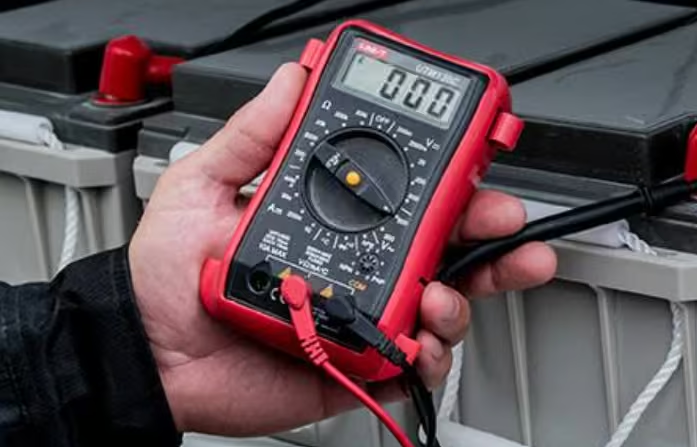
Fault finding after a supply interruption is methodical work rather than a guessing game: isolating circuits one at a time, testing insulation resistance, checking terminations that may have loosened over years of heating and cooling, and finally let go when the supply came back hard. The point is to find the cause rather than replace the device that tripped, because a breaker doing its job is reporting a problem, not being one.
Sometimes the board is the problem. Ceramic fuses, no RCD protection on the power circuits, or a board so full there’s nowhere left to land a new circuit. A full switchboard upgrade is the honest answer at that point, and putting it off tends to get expensive in a different way.
Power outages across Canberra are usually Evoenergy’s to fix, and when the street comes back on with your house still misbehaving, that’s ours. Nathan and the team have been sorting out Canberra switchboards for two decades, and we’ll tell you straight if the answer is a phone call to the network rather than a job for us. Book a licensed Canberra electrician or call 0440 138 246.