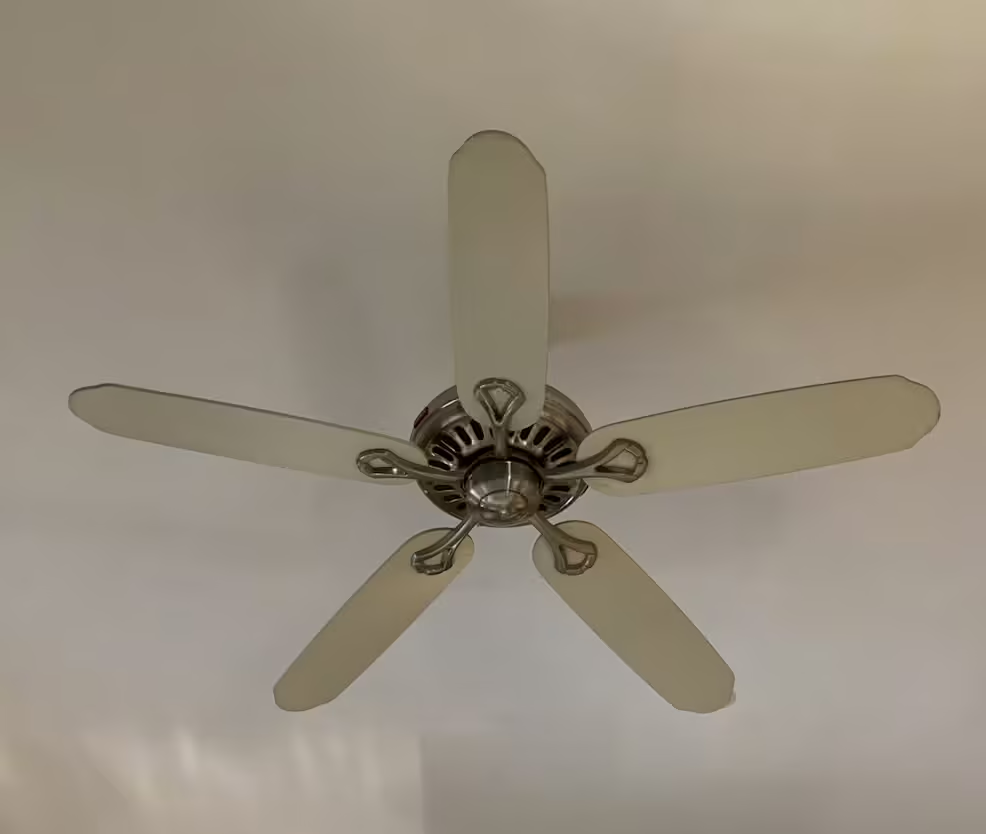
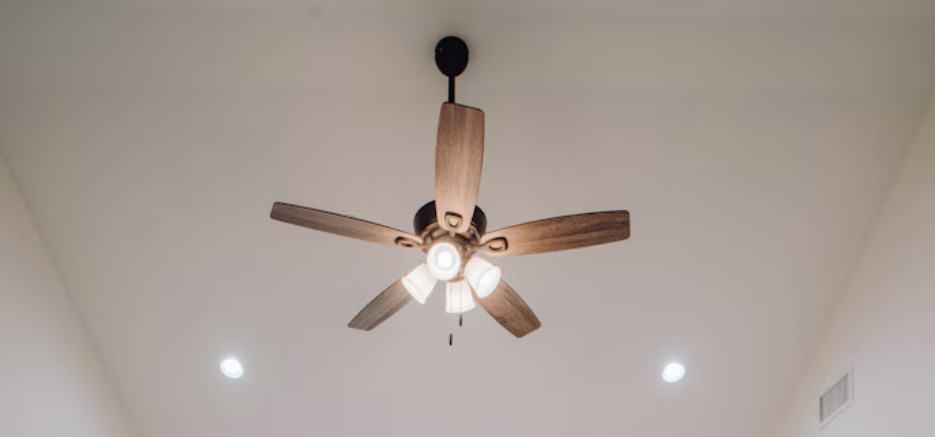
Yes. In most Canberra homes, you can put a ceiling fan where a light is, and it’s usually the best place for it, because the cable is already sitting in the ceiling. What changes is the fixing. A light hangs off plasterboard. A fan needs timber above it, and the whole job is built around getting that right.
Which fan to buy takes five minutes to decide once the fixing is sorted. The fixing is where the time goes, particularly in a house where nobody has been up in the roof space since the insulation went in.
Should the fan replace the light or go beside it?
Replace the light. The cable is already up there when you’re installing a ceiling fan where a light fixture exists, so the swap is usually the cheaper job, and the room keeps one fitting in the middle of the ceiling.
Plenty of people ask for the fan beside the downlight instead. Keep the light, add a fan half a metre away, lose nothing. Then the fan goes on, the blades sit between the light and the room, and the light strobes through them for as long as it runs. Of all the layouts we get asked about, this is the one we’re most often called back to change. A fan in a new position also needs its own cable run from the light point, plus the labour that goes with it.
You don’t lose the room’s light either. A fan with a built-in light is only slightly dearer than the same model without one, and for bedrooms we nearly always quote the combo when someone books a ceiling fan installation.
What holds a ceiling fan up if the light was fixed to plasterboard?
Timber. A light fitting weighs next to nothing and plasterboard alone often carries it, but a fan is heavy, it spins, and it vibrates, so it has to be fixed to a joist or to blocking fitted between the joists.
Most domestic fans come in at around five to fifteen kilos once the blades are on. Occasionally the old light sits right under a joist and the fan bracket screws straight into it. More often it sits between two, and the job moves up into the roof space. We fit a noggin there (a length of timber blocking cut to fit between the joists, directly above the hole) and hang the fan off that. Where a noggin can’t go in, an adjustable metal ceiling fan support brace spans the joists and does the same work.
Plasterboard is never the fixing. Neither is a patch. If someone tells you the old hole was patched so it’ll hold the fan, that patch was never meant to hold anything heavier than paint.
When a fan does come down, the fixing is nearly always why.
What happens to the old downlight hole?
In most cases it disappears under the fan. Once the noggin is in, the canopy (the dome at the top of the fan that hides the bracket) usually covers a standard downlight cut-out without any plastering.
A hole slightly too wide for the canopy takes a cover plate or extension ring. Position is the bigger question. Many rooms have a grid of downlights with nothing at the true centre, and a fan with a 1200 mm blade sweep makes even 300 mm of drift obvious from the doorway. So we patch the hole and centre the fan. Put it off-centre to dodge a patch job, and you save an afternoon of plastering, then look at it every night for the next fifteen years.
How does the fan switch on if the light only has one switch?
Usually through a remote. A light point normally has one switched cable, so a fan wired straight to it comes on and off with its light. A remote-controlled fan gets around that without any new cable to the wall: the wall switch becomes the fan’s isolator, and the remote handles fan speed and light separately.
The weak link is habit. That wall switch has to stay on, and people flick it off on the way out of the room, then wonder why the remote has stopped working. We fit the remote’s wall cradle right beside the switch, which sorts out most of those calls before they happen.
Separate wall switches for fan and light can be done with a new cable from the switch up to the ceiling. Straightforward with decent roof access. Messier without it.
Any existing dimmer comes out. A light dimmer chops the power in a way fan motors don’t tolerate, and the motor ends up humming and running hot. If the room went to LED a few years back, it probably got a trailing-edge dimmer at the time, so that gets swapped for a standard switch and the dimming moves to the fan’s own control.
Which fan suits a light point swap?
A DC fan from an established brand, with an LED light built in, suits most Canberra bedrooms and living areas.
Fan lights used to be the weak point. Dim and yellowish. Current LED kits are bright and dimmable, and most switch between warm and cool white. In a room up to about 4 x 4 m, the fan light carries the room by itself; beyond that, a couple of downlights towards the corners on a dimmer fill the gaps, kept clear of the blade sweep so the strobe doesn’t come back.
DC motors earn their price. Six speeds instead of three is the obvious difference, though the quieter running is what people mention afterwards. On a middle setting, a DC fan draws less than a single old 60 W globe. The trade-off is a remote-only setup and more electronics inside the motor that can eventually fail. AC fans cost less upfront and suit a spare room that rarely gets used.
Stick with known brands. No-name fans take longer to assemble and their remote receivers barely squeeze into the canopy, which nobody enjoys at the top of a ladder.
Canberra gets more out of the reverse switch than most places. On low in winter mode, the fan pushes warm air that pools at the ceiling back down the walls. Put one near a ducted or split system outlet, and it moves the conditioned air around the room in either season.
Is swapping a light for a fan an easy job?
Half true. A newer home with a roomy roof space and the light under a joist is quick work. Older homes are where the hours go, and the reason sits above the ceiling.
Tight joist spacing slows things down, and so does old cable that has gone brittle and cracks when it’s moved. A ceiling light point is often a junction as well, with two or three cables joined behind it feeding other lights. What comes down with the old fitting isn’t always one light’s worth of wiring.
Some Canberra houses built before 1980 were insulated with Mr Fluffy loose-fill asbestos. The ACT Government still publishes a register of affected properties, updated monthly, and it still picks up the odd new address; one was added as recently as April this year. We check it before anyone goes into the roof of an older house.
The circuit itself is seldom the problem. LED lighting has cut the load on lighting circuits so far that a fan barely registers.
How to put a ceiling fan where a light was: what the job involves
Anyone looking up how to install a ceiling fan will find hours of video, most of it American and none of it covering ACT licensing. Here, fixed wiring is licensed electrical work, tested and certified like any other. A typical swap runs like this:
- Power off at the switchboard, the circuit proved dead, old fitting down.
- A look in the roof space: joist position, what cables meet at the point, and the asbestos register for older homes.
- Noggin or brace fitted above the hole, then the fan bracket fixed to it.
- New cable run if you want separate switching, and any dimmer replaced.
- The fan is assembled, wired, balanced and tested, with the blades at least 2.1 m off the floor.
- A Certificate of Electrical Safety goes to Access Canberra and to you. The form even has its own box for fan, light and heater loads.
What does ceiling fan installation cost?
Ceiling fan installation cost depends far more on what’s above the ceiling than on the fan you choose. A swap under a joist, with easy roof access and the existing switch kept, sits at the low end.
A noggin adds a little. A new cable down to the wall for separate switching adds more, particularly under a low roof pitch where there’s barely room to crawl. Several fans in one visit bring the cost per fan down, since setup and testing are shared.
If you’re comparing quotes for ceiling fan installation in Canberra, check whether the fixing is included or left to be added once the electrician is in the roof.
Getting a fan swap quoted
If you’re weighing up whether you can put a ceiling fan where a light is in your own home, a quick look above the ceiling answers most of it. Watts Needed is a family-run team of licensed electricians working across Canberra. We check the fixing before we quote, so the price you get already accounts for what’s up there. Call 0440 138 246 or book a quote online.
FAQs
Can you install a ceiling fan where a light is if there's no joist above it?
It can be done. A noggin fitted between the joists from the roof space gives the fan solid timber to hang from, and most of these jobs are done exactly that way.
Do I need an electrician to install a ceiling fan in the ACT?
Can you put a ceiling fan where a light is on a raked ceiling?
Is a 2.4 m ceiling high enough for a fan?
For a close-mount fan, yes. Blades must sit at least 2.1 m above the floor, and a close-mount on a standard 2.4 m ceiling clears that, if not by a lot.