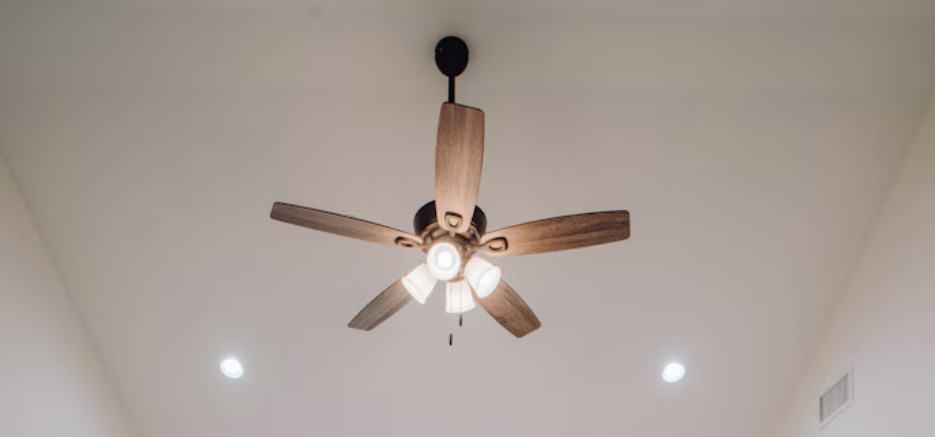
What size ceiling fan a room needs starts with floor area. Most Canberra bedrooms suit a fan in the mid-40s, and 48 inches covers the bulk of them. Living rooms of around 4 x 5m take a 56 or a 60, while small bedrooms and studies sit under 44.
The room itself then gets a say. Look up three sizing charts and you’ll find three answers for the same bedroom, because no chart can see the ceiling height, the downlights or the fact that the fan will spend most of its life on speed one. We treat any ceiling fan size chart as a rough guide and size to the room in front of us.
Canberra puts more weight on ceiling fan size than a milder climate would. Last summer the airport averaged close to 30 degrees through the season, nearly two above normal, and January closed out with three days over 40. By June those same bedrooms are sitting under frost, and the fan has a different job.
If a new split system is also on the list, measure once. Sizing an air conditioner starts from the same room dimensions.
Ceiling fan size chart: what size ceiling fan for a room?
Match ceiling fan size to room size by floor area first, then adjust for ceiling height and layout. The spans below assume a typical Canberra room with a flat 2.4m ceiling.
Room | Floor area | Blade span (in | Blade span (cm) |
Study, nursery or small bedroom | Under 9 m² | 6 to 42 | 90 to 107 |
Standard bedroom (3 x 3m to 3.5 x 3.6m) | 9 to 13 m² | 44 to 48 | 112 to 122 |
Main bedroom with walk-in or ensuite | 13 to 18 m² | 48 to 52 | 122 to 132 |
Living room or rumpus | 18 to 25 m² | 56 to 60 | 142 to 152 |
Open-plan living | Over 25 m² | Two fans, 52 to 56 each | 132 to 142 each |
Covered alfresco or patio | The covered area | 52 to 60 | 132 to 152 |
Australian stores label ceiling fan sizes in centimetres about as often as inches, so the same fan can be a 132cm on one shelf and a 52″ on the next.
How to measure ceiling fan size
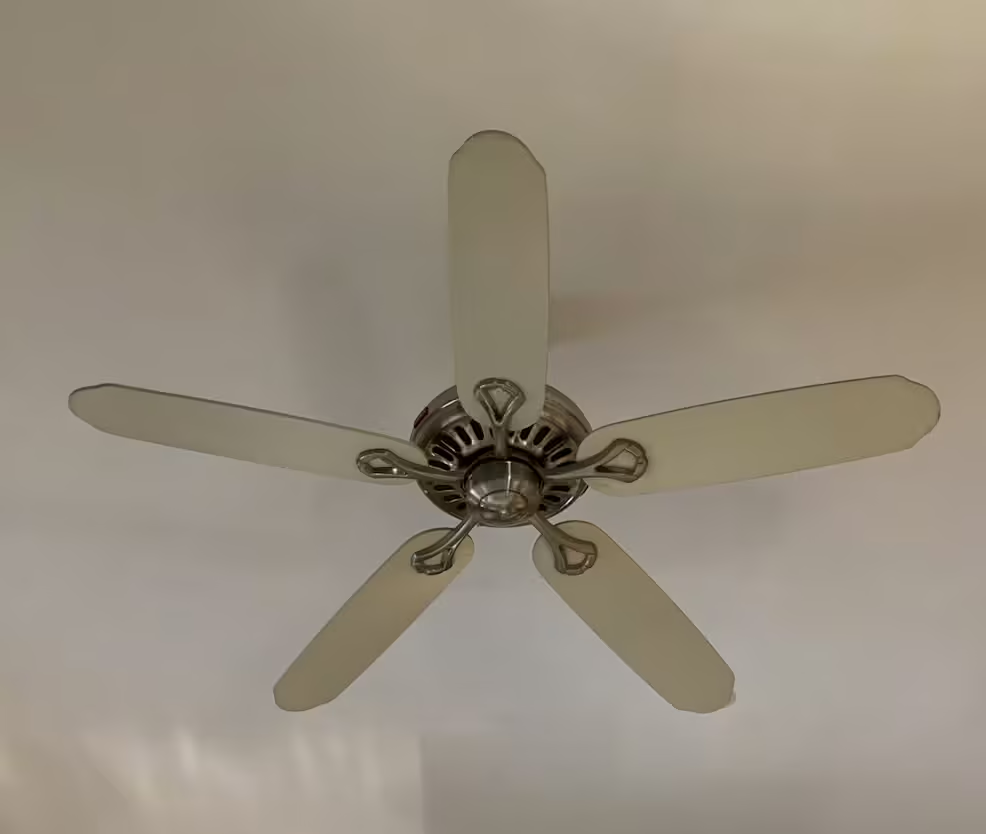
Measure blade span from one blade tip, straight across the centre of the motor, to the opposite tip. Three-blade fans have no opposite tip, so measure centre to tip and double it.
Manufacturers quote ceiling fan size as that one figure, in inches, centimetres or both.
Rooms are length by width, in metres. Open plan is the awkward one. A fan over a long open-plan slab only has to reach the lounge, so measure the seating zone and leave the kitchen bench out of the sum.
Ceiling height is the number most people forget. Under AS/NZS 3000 the lowest point of the blades sits at least 2.1m above the floor, and manufacturers want around 300mm between the blade tips and any wall. Both get checked on every ceiling fan installation before a bracket goes up. On a raked ceiling we measure the pitch as well. Plenty of fans are rated to about 15 or 20 degrees of slope and no steeper.
What size ceiling fan for bedroom use?
A standard bedroom suits the mid-40s. Choose between models on their low-speed airflow, since top speed barely matters in a bedroom.
A 52 will fit in most bedrooms, but that’s more fan than the room needs, and the extra span shows up as noise.
Speed one deserves most of the attention. People rarely touch the top setting, even through a stretch like the last week of January, so the fan spends its nights turning slowly about a metre and a half above someone’s head. Spec sheets list airflow in cubic metres per hour. Usually for high speed only, and usually somewhere near the back. Ask for the low-speed figure anyway. A few smaller fans move more air on speed one than the next size up. For a bedroom, we’d take one of those over a bigger fan every time.
Run the fan on low and set the split system a couple of degrees warmer than usual. The fan makes up the difference.
What size ceiling fan for small bedroom spaces?
Anything under 44 inches, once the room drops below about 9m². A big fan in a room that size hangs right over the bed and pulls the ceiling down with it, which shows more on a 2.4m ceiling. Slim designs help if you want to push the span, because most of a fan’s visual weight is in the motor housing.
What size ceiling fan for living room areas?
Save the 50s for living spaces. A living room of around 4 x 5m handles a 56 or 60 inch fan comfortably, even if that looks big on the plan.
Where a room can take a larger fan, give it one. A big fan turning slowly beats a small one working hard. Quieter, and cheaper to run.
What size ceiling fan for large room layouts?
Above about 25m², no single recommended ceiling fan size covers the space properly. Two matching fans, one over the lounge and one over the dining table, beat one huge fan in the middle of the ceiling, which tends to end up hanging over the walkway. Keep them about 3m apart.
Does ceiling height change what fan you need?
Often more than floor area does. On a 2.4m ceiling, the drop of the fan limits your choice more than ceiling fan size.
Take the 2.1m blade clearance off a 2.4m ceiling and 300mm is left for the whole fan body. Look for a low-profile fan with a drop of around 210 to 230mm. Low-profile models come in fewer ceiling fan sizes, so the shortlist gets short quickly. Plenty of Canberra homes sit right at 2.4m, including most of the older brick houses and a good share of project builds.
What size ceiling fan for high ceiling rooms?
Above 2.7m or so, the fan needs a downrod to bring the blades down to roughly 2.4 to 2.7m off the floor, where people are. Go up a size as well, because the air has further to travel before it reaches anyone. On a raked ceiling the mount has to suit the pitch, and the blade tips need about 60cm clear of the low side of the slope.
What size ceiling fan for outdoor patio areas?
Size it to the covered area you sit under, usually 52 inches for a typical Canberra alfresco. Check the IP rating before the size.
A covered alfresco that stays out of direct rain needs IP44 at minimum. Open-sided pergolas and patios that catch wind-driven rain want IP55 or higher. The light kit needs the same rating as the fan body. An IP44 fan with an IP20 light fails the first time the light gets wet.
A 52 inch spreads air over a circle a little over 3m across. A long alfresco running the width of the house takes two.
Is a bigger ceiling fan always better?
No. Past a certain width the fan can’t draw air back down around its own blade tips.
Put a 60 inch into a 3.5m bedroom and most of what it moves stays up near the ceiling. The bed gets the noise.
Manufacturer ratings beat any generic chart here. When a brand lists a recommended ceiling fan size for a given room, it has already allowed for the blade pitch and motor speed of that exact model, which a square-metre table has no way of knowing. Search “ceiling fan size calculator australia” and most results ask for one input, floor area. Fine for a first pass. Most ceiling fan size guide tables online stop at the same point.
Floor area gets you a shortlist of what size ceiling fan to look at. The data sheet narrows it, because ceiling fan size on its own says nothing about how hard the motor pushes.
Will a ceiling fan strobe with my downlights?
It can, even when the blades clear the fittings on a tape measure. Leave more distance between the blade tips and the nearest downlights than the minimum.
Strobing is the flicker you get when spinning blades pass under a light source and chop it up across the walls. The fittings don’t have to sit close to the blades to cause it. On a retrofit, expect one or two downlights to move.
The light built into a fan is rarely enough for a main bedroom or living room on its own, so keep the downlights or plan to add some.
Should every fan in the house match?
Matching works, with a compromise on ceiling fan sizes in at least one room.
One model throughout usually means dropping a size in the living area or going up one in the bedrooms. We’d go up in the bedrooms before we’d shrink the living room fan. One visit for the whole house also brings the per-fan cost down.
AC or DC motor?
Whatever size you settle on, make it DC. DC fans are noticeably quieter on low and use up to around 70% less power than an AC fan on the same setting. AC still suits a spare room that gets used a handful of nights a year.
Does a ceiling fan help in a Canberra winter?
Yes. Switched to reverse and run slowly, the fan pushes warm air that has pooled at the ceiling back down the walls without blowing a draught across the room. Your reverse cycle or gas heating can then hold the room at a lower setting. Larger fans do this job better, since they move enough air at a crawl.
Get the size right before the fan goes up
Watts Needed is a family-run electrical business based in Googong, and Nathan has 20 years in the trade. We check the ceiling height and the downlight layout before recommending a fan, then install it to AS/NZS 3000.
If you’d rather not work out how to size a ceiling fan for every room yourself, or you’re still deciding what size ceiling fan suits the living room, request an upfront quote or call 0440 138 246.
Ceiling fan size FAQs
What size ceiling fan do I need for a 3 x 3m bedroom?
A 44 inch. A 48 also works if you like more breeze on low.
Is there a standard ceiling fan size?
Not officially. 52 inches (132cm) is the size most Australian retailers stock deepest, so it gets treated as the default on most ceiling fan size guide pages. For a typical Canberra bedroom that’s a size or two bigger than necessary.
How to measure ceiling fan size on a fan that's already up?
Fan off and fully stopped, then the same tip-to-tip measurement as a new fan. Leave the canopy and fixings alone. A fan that wobbles or has a dropped canopy needs an electrician to check the mounting.
What size ceiling fan for bedroom ceilings at 2.4m?
Any span the floor area calls for, in a low-profile body. Hugger-style fans mount close to the ceiling and are the usual choice.
Can I install a ceiling fan myself in the ACT?
No. Ceiling fan installation is electrical work, and in the ACT it must be carried out by a licensed electrician.