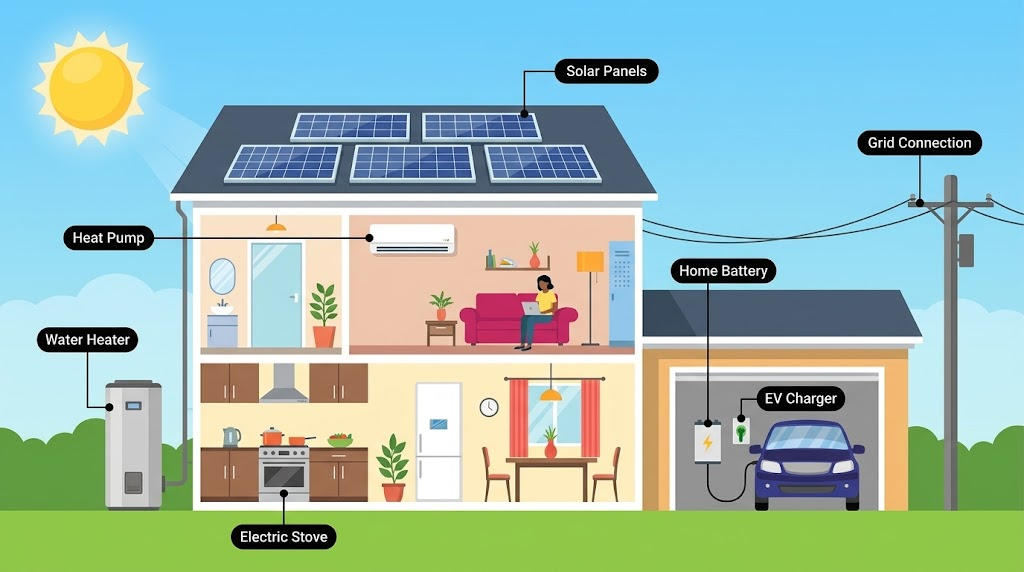
Going all-electric starts with a switchboard inspection and a maximum demand calculation, done before any appliance is bought. Most homes stay on single-phase power. Some need a switchboard upgrade. The expensive surprise usually sits on the network side, where only your distributor can say what the street will supply.
Home electrification budgets tend to blow out on the electrical upgrades, often after the cooktop or battery has already been paid for.
What counts as an all-electric home?
No gas connection at all. Hot water, heating and cooking all run on electricity, and the Australian Government’s preferred replacement for gas heating is efficient reverse-cycle air conditioning. Heat pump hot water can use roughly 30% of the energy of a conventional electric system.
Plenty of home electrification projects stop short of that. One gas appliance left behind keeps the supply charge on the bill, which is why the last appliance deserves as much planning as the first if you want to ditch gas for cost reasons.
What electrical upgrades do you need to go all-electric?
Some combination of the six below, and rarely all of them. The last column shows who makes the call on each.
Electrical upgrade | Usually needed when | Who confirms it |
Switchboard upgrade | The board has no spare space, still has ceramic fuses or lacks a safety switch (RCD) on the required circuits | Licensed electrician |
Dedicated circuit | An induction cooktop, heat pump hot water system, reverse-cycle air conditioning or EV charger needs its own protected circuit | Licensed electrician |
Consumer mains | The cable between the point of supply and your switchboard is undersized for the calculated load | Electrician and distributor |
Meter box upgrade | The meter position or enclosure no longer meets the distributor’s rules | Electrician and distributor |
Electricity supply upgrade | The existing connection lacks the electrical capacity for the planned load | Distributor |
Rewiring | Unsafe or non-compliant wiring is found during the work | Licensed electrician |
Rewiring is the one thing people fear most and need least often. The Victorian Government’s all-electric guide says electrifying gas appliances won’t by itself require a rewire, although unsafe or non-compliant wiring found along the way must be fixed. Upgrading electrical wiring in an old house can become a separate job for that reason.
Why should the maximum demand calculation come first for an all-electric home?
Maximum demand is the largest load your home is expected to draw at one time. That figure sets the electrical capacity you need. Cable, board and supply are sized from it. Online guides tend to bury it halfway down the page. It belongs at step one.
AS/NZS 3000 recognises four methods: calculation, assessment, measurement and limitation. Which one applies is your electrician’s call.
The result is often lower than people fear. An induction cooktop, oven, heat pump hot water system and air conditioner will rarely all run flat out together, and the rules allow for that, so nobody has to run oversized cable for a single hotplate. Several efficient appliances overlapping at peak can still pull a lot of power, as RACV points out.
Base the home electrification plan on the loads you expect in five years. A future EV and battery can change the size of the switchboard, consumer mains and inverter you should install today. One homeowner who added a battery after solar effectively paid for the inverter twice.
Do I need a switchboard upgrade to go all-electric?
You need a switchboard upgrade when the existing board lacks the switchboard capacity for new circuits or is found to be non-compliant. Older homes are the most likely candidates.
Ceramic fuses, a full board and missing safety switch protection are the usual signs. Weather exposure, exposed cabling and suspected asbestos are more urgent, and one Sydney Federation home with all three made a strong case for replacing the board and relocating it into a lockable enclosure.
Compliance can make the decision for you. Victorian Government guidance says a non-compliant or potentially unsafe switchboard identified during electrification must be upgraded by law. The ACT Government also notes that electricians must bring the installation up to the current AS/NZS 3000 standard when upgrading.
Renovating? Do the electrical switchboard upgrade while the walls are open. Relocation is easier then, and new finishes stay untouched.
You may also see this called an electrical panel upgrade, which is the American term for the same job.
How much does a switchboard upgrade cost?
Switchboard upgrade cost depends mostly on the number of circuits, the board’s location and what the electrician finds behind it. Ask for asbestos removal, relocation, new consumer mains and any meter box upgrade as separate lines on the quote.
A phone figure for the cost to upgrade a switchboard means little until someone has looked inside it. Get the price in writing after a site visit.
Do I need three-phase power for an all-electric home?
Probably not. The ACT Government says most homes won’t need three-phase power to go all-electric, and a single-phase supply can run ducted reverse-cycle air conditioning, induction cooking, two ovens and solar in many homes.
Three-phase power earns its cost in specific situations:
- A three-phase air conditioner or other three-phase equipment is part of the plan.
- You want an 11 to 22kW EV charger.
- A larger solar system would benefit from the higher export limit, because distributors cap export per phase.
- The street has tight per-phase limits. One Melbourne property was limited to 40A per phase.
Check your existing connection first, as underground supplies often come as three-phase already. If an electrician still recommends you upgrade to 3-phase, the question to ask is which load requires it, and whether load management could cover it on single-phase. A good electrician will have no trouble answering.
Why can the network side cost more than the switchboard?
Your electrician can quote the switchboard, but only your distributor can say what electrical capacity the street has. Many old inner-suburb mains were sized for homes that ran on gas, and the upgrade may involve the distributor’s equipment as well as your own wiring.
This is where many all-electric home projects stall. Homeowners on Reddit describe combined network and electrical quotes large enough to keep them on gas, including one Melbourne terrace owner on the CitiPower network who began considering a gas reconnection.
Distributors such as AusNet may also charge for a firm offer. The application needs a property sketch and a full load estimate. A fee for an answer seems odd until you see what the answer can be, which runs from no work required to major street infrastructure.
Raise these options before accepting the first quote:
- Upgrading the existing overhead supply
- Installing a private pole
- Pricing directional boring separately
- Getting a second electrical quote
Directional boring shows the widest gap in these accounts: several homeowners paid under half the first quote by booking a contractor themselves.
Can a home battery avoid a supply upgrade?
It has worked for some homes. Certain inverters cap grid import at a set level, 32A for example, and let the battery cover the peaks; one owner on a small lead-in has run six months self-sufficient on 13.5kW of solar and a 36kWh battery.
The catch sits in the calculation. Solar and battery generation is usually left out of maximum demand because it’s intermittent. Whether a battery or load management can avoid an electrical service upgrade is a question for your electrician and distributor, and you need that answer before paying for the system. Solar sales pages tend to skip this.
The federal Cheaper Home Batteries Program rebate also steps down on a set schedule through 2030. Include that in your electrification budget, but let the household’s load and tariff decide the purchase.
What sits behind each appliance swap in an all-electric home?
Induction cooktop
“Just swapping the cooktop” can mean a new 32A dedicated circuit from the board, a possible switchboard upgrade, benchtop modifications and a plumber to cap the gas. A five-element induction cooktop can pull about 12kW at full load. If cooking on it is the worry, try a cheap portable unit first. One chef in these threads said she prefers induction.
Heat pump hot water
The unit sits outdoors and makes some noise, so keep it away from bedroom windows. Many heat pump hot water systems have a timer, which lets them run on daytime solar. An electric hot water upgrade is far easier when arranged in advance, because a failed unit on a Sunday usually gets replaced gas-for-gas. That locks in another decade of gas.
Reverse-cycle air conditioning
Each split system typically runs on its own dedicated circuit. To upgrade gas ducted heating to electric, your electrician will also need the size of the proposed ducted reverse-cycle air conditioning unit, which is often the largest single load in the home.
EV charger
Most drivers only need a 7kW single-phase EV charger. Overnight charging at that rate covers a typical day’s driving, and 22kW is hard to justify at home. Expect more EV charging work the further the parking spot is from the switchboard. In an apartment or townhouse, you’ll also need owners corporation approval, and probably changes to shared infrastructure.
What order should you electrify your home in?
Electrify on failure, but plan before the failure. Nobody needs to replace a working Miele cooktop.
- Audit 12 months of gas bills and electricity bills.
- Get the maximum demand calculation and switchboard inspection done.
- If a supply change looks likely, apply to the distributor.
- Finish the residential electrical upgrades, timed around any renovation.
- Deal with insulation and draught sealing. They cut the heating load before you size anything.
- Replace each gas appliance at end of life, using the plan already agreed. Reverse-cycle air conditioning and heat pump hot water usually offer the biggest running-cost gains.
- Arrange gas disconnection once the last appliance has gone.
Forced electrification decisions happen too. One household found a gas leak during a routine meter swap and chose to electrify when re-piping became the alternative.
Is home electrification worth the money?
An all-electric home is most likely to pay off when appliances are due for replacement anyway, and the last gas connection can be removed. A family member telling you to put the money in the mortgage offset may have a point if your gas appliances are young and your use is low.
Home electrification savings depend on your gas bills, which vary too widely for a national answer. Some WA commenters reported small monthly gas bills, while one Melbourne household described very high winter ones. Look at the total energy bill. Your electricity bill will go up after switching from gas, and that alone tells you nothing.
Upgrade costs should be measured against what a like-for-like replacement would cost you anyway, after any home electrification rebates. Also count the supply charge. One commenter’s gas usage came to roughly half what they paid in supply charges, so the larger saving only arrived when the meter went. Evening-heavy households without a battery should run the numbers carefully, as some can finish up worse off.
The benefits of electrification aren’t only financial. Gas cooktops release nitrogen dioxide into the kitchen, which an induction cooktop doesn’t. Several parents said indoor air was why they got off gas, one of them ahead of a newborn’s arrival. Your GP is the person for specific health questions.
Does Victoria’s 2027 gas ban apply to existing homes?
Only for hot water. Victoria’s new electrification rules take effect for new homes on 1 January 2027, with permit timing deciding some cases. Existing homes follow from 1 March 2027, and only when a gas hot water system can no longer be repaired or safely maintained. At that point, its replacement has to be electric, usually a heat pump hot water. Apartment buildings with centralised hot water are excluded.
Heating is where articles often get this wrong. Owner-occupiers face no change to heating. Rentals are held to more: gas heaters at end of life must go electric as well.
Outside Victoria, the rules and electrification programs differ by state and territory.
What’s the first step to electrify your home?
Book the switchboard inspection and maximum demand calculation before buying appliances or a battery. Send your electrician a list of the gas appliances going, along with any EV, solar or battery plans, and you’ll have a clear list of the home electrical upgrades you need, plus the questions for your distributor.