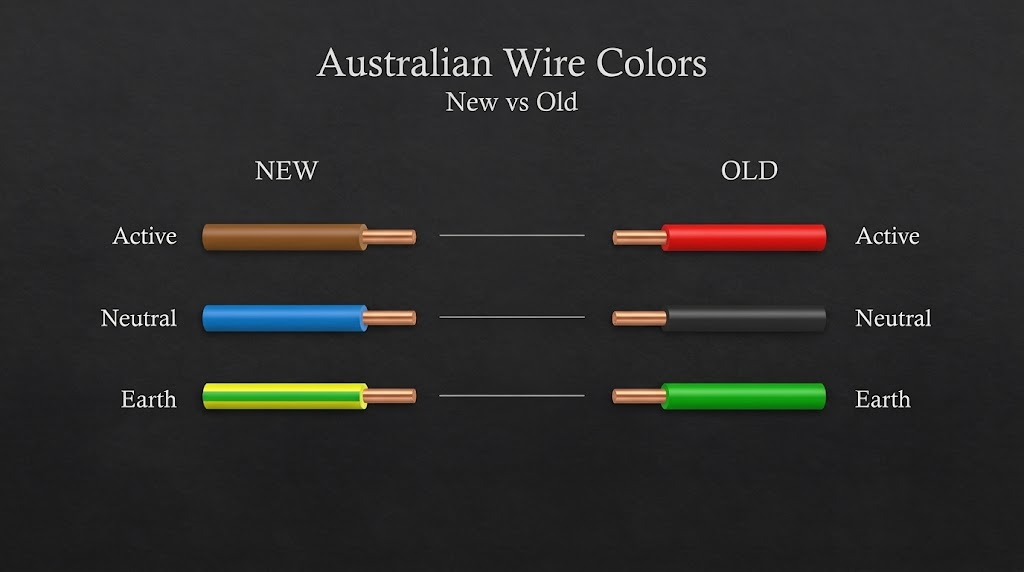
Electrical wire colours in Australia follow AS/NZS 3000, the Wiring Rules. In modern single-phase wiring, the active is brown, the neutral is blue, and the earth is green/yellow. Older homes often have a red active, black neutral and solid green or bare earth, and the standard still permits red and black in fixed wiring today.
Colour tells you what the installer intended. A licensed electrician tests every conductor before touching it anyway, because what a wire was meant to do and what it’s doing now can differ.
What colour is active, neutral and earth in Australia?
Brown is active, blue is neutral and green/yellow is earth on a modern 230V single-phase circuit. Red, black and green are the older electrical wiring colours Australia used for the same three jobs.
Conductor | Current colour | Older colour | What it does |
Active (live) | Brown (red still permitted in fixed wiring) | Red | Carries 230V from the switchboard to the load |
Neutral | Blue or light blue (black still permitted in fixed wiring) | Black | Returns current to the switchboard, and can carry voltage |
Earth | Green/yellow | Solid green, or bare copper in very old homes | Gives fault current a path so the safety switch or circuit breaker trips |
Most people still call them 240V wire colours in Australia, even though the nominal supply dropped to 230V around 2000. The 240V wiring colours and the 230V ones are the same set.
Green/yellow is the one colour you can lean on. AS/NZS 3000 reserves it for earth and bonding and bans it from every other job. Even so, older work bends the rule from the other side: plenty of homes wired before the striped earth arrived have solid green earths, and some of the oldest houses in the country still have bare copper earth conductors in the ceiling.
When did Australian wiring colours change?
The colour of electrical wires in Australia changed on no single date. Flexible cords moved to brown and blue decades ago, while the fixed wiring in your walls can still be red and black in a house wired this year.
Search for the changeover date, and you’ll find three different answers. Some guides say 2000, when Australia aligned with the IEC 60445 colour scheme. Others say 2018, the year the current edition of AS/NZS 3000 came out. At least one manages 2018 and 2021 on the same page.
The confusion comes from two kinds of cable changing on different timelines.
Flexible cords are the leads on kettles, lamps and extension cords. They moved to brown active and blue neutral in the early 1970s, and they’re the cable most people picture when they look up Australian wiring colours.
Fixed wiring is the flat TPS cable run through roofs and walls. AS/NZS 3000 Table 3.4 sets the wire colour codes Australia uses for installation wiring separately: green/yellow for earth, black or light blue for neutral, and almost any other colour for the active, with red or brown the usual choice. Red/black TPS is still the most common flat cable on Australian sites.
So a 2026 renovation can legally be wired in red and black, while a toaster from 1985 has a brown and blue lead. Neither tells you how old the house is.
Is red and black wiring still legal in Australia?
Yes. Red and black wires in Australia that complied when installed don’t need replacing because of their colour, and new fixed wiring may still use a red active and black neutral.
The old wiring colours in Australia are red active, black neutral and green earth. Plenty of Australian ceilings still carry these old electrical wiring colours, and houses full of them pass an electrical safety check every week. The colour has never been the defect.
The insulation is. Rubber-insulated cable from the 1950s and 60s goes brittle and cracks when it’s moved. Early PVC hardens around light fittings where heat has cooked it for decades. Once you can no longer read the colour on a conductor because the insulation has faded or flaked away, the protection around the copper is failing, and that cable belongs on a rewiring quote.
Where new cable joins old, the new work goes in current colours and the junction gets labelled, so the next electrician knows two eras of old and new wiring colours meet there. Old yellow conductors get white sleeving at new terminations. Bare earths get green/yellow sleeving.
House age is a poor guide to any of this. Partial rewires, extensions and the odd unlicensed repair mean a 1970s brick veneer in Kambah can have three colour schemes in one ceiling.
If someone recommends a full house rewiring job on colour alone, ask them what they found wrong with the insulation.
What does a black wire mean in Australian wiring?
Black can be a neutral, a phase, a switched active or a DC negative depending on where you find it. Treat it as the least trustworthy colour in the house.
Under the old Australian wiring colour codes, black was neutral, and the current Australian wiring colour codes for fixed wiring still allow it there. On three-phase cable and imported equipment wired to the European scheme, black is the second phase, L2, carrying full voltage. One colour, opposite jobs, sometimes inside the same switchboard.
Light switch wiring in Australia adds another twist. A switch loop in red/black TPS sends the active down to the switch on one core and brings the switched active back up on the other, and in many older homes that return core is black. Correct practice is to sleeve or tape it red at both ends. Plenty never were.
Outside the house, black means hot in American wiring and negative on a car battery or a solar DC cable. Anyone who learned their colours from a US video or a car stereo install carries that meaning into an Australian ceiling.
A black conductor is live until a tester proves otherwise.
What are the three-phase wiring colours in Australia?
Current three-phase colours are brown, black and grey for the phases, with a blue neutral and green/yellow earth. Older installations use red, white and blue phases with a black neutral and green earth.
Conductor | Current (IEC 60445 scheme) | Older Australian scheme |
Phase L1 | Brown | Red |
Phase L2 | Black | White |
Phase L3 | Grey | Blue |
Phase L4 | Blue | Black |
Phase L5 | Green/Yellow | Green |
Read the two columns together, and the problem is plain. Old neutral is black, and new L2 is black. Old L3 is blue, and new neutral is blue. Someone reading one scheme onto the other can mistake a phase for a neutral twice over. The brown, black and grey set is the European 3-phase colour code, which is why it shows up first on imported machinery and newer switchboards.
Three-phase power turns up in Australian homes running an EV charger or a full move off gas. The local network approves the supply (Evoenergy in the ACT), and anyone weighing it up can read how to upgrade to three-phase power before the colours even come into it. A board with circuits added over several decades often carries both schemes of 3 phase colour coding.
Can you tell if a wire is live by its colour?
No. Electrical wire colours in Australia record what the installer intended, and only a voltage test tells you what’s on a conductor right now.
Anyone who does electrical fault finding for long enough has opened a fitting where the colours were wrong. Someone ran short of red, a DIY repair used whatever cable was in the shed, an old switch loop was never sleeved. Nobody recolours a wire after its job changes. Electrical wiring colour coding records the day a cable went in, and the wire colour meaning on any chart describes that day only.
Testing follows a fixed order: isolate the circuit at the switchboard, prove the voltage tester on a known live source, test the conductor, then prove the tester again. Low voltage technicians shorten all of that to “when in doubt, meter it out”.
Neutral deserves its own warning. AS/NZS 3000 classes neutral as an active conductor because it carries current back to the switchboard, and a loose or failed neutral connection upstream can leave the neutral wire colour you trust sitting at full voltage. A blue wire can give you a serious shock.
Electrical safety regulators across Australia record somewhere around ten electrical deaths a year, and customer installations and appliances sit behind a share of them.
Colour blindness is one more reason to trust the tester over your eyes. About one in twelve Australian men has some red-green colour deficiency, and red, brown and green blur together for them.
Why don’t the wires match my YouTube tutorial?
Most wiring videos online are American or British, and both use electrical wire colours that clash with Australian electrical wire colours. Black causes the most trouble.
Conductor | Australia | United States | United Kingdom |
Active/live/hot | Brown (red in older and some fixed wiring) | Black, sometimes red | Brown (red before 2004) |
Neutral | Blue (black in older and some fixed wiring) | White | Blue (black before 2004) |
Earth/ground wire | Green/yellow (green in older homes) | Green or bare copper | Green/Yellow |
The UK column looks closest to electric wire colours in Australia, and for modern work it is. The US column is where people get caught. A black wire in an American video is the hot conductor, and white is neutral. American homes also run at 120V, so advice about what’s safe to touch doesn’t travel.
A white wire in Australian electrical wiring is usually an old three-phase conductor, since white was the second phase, or a core in a control or data cable. Occasionally it’s a switched active in an older install.
A homeowner who stops halfway because the wall doesn’t match the video has made the right call.
Australian plug wiring, appliance leads and DC colours
Appliance leads use brown active, blue neutral and green/yellow earth, the same electrical wire colours Australia uses for new fixed wiring. DC wiring follows its own convention, usually red positive and black negative.
Australian plug wiring
Hold an Australian plug with the pins facing you and the earth pin at the top. Active sits on the right and neutral on the left, as any Australian plug wiring diagram shows. Plugs made since the mid-2000s carry an insulated sleeve near the base of the active and neutral pins, so a half-inserted plug can’t be touched live.
Brown, blue and black on one lead
A two-core lead with brown and blue wires and no earth usually belongs to a double-insulated (Class II) appliance, marked with a square inside a square. Brown, blue and black together on one cable is more often a sensor or control cable than a mistake, and that black core can be a switched live.
Is red positive or negative?
Positive and negative wire colours in DC work are a separate convention: red is positive and black is negative on car batteries and most solar PV cabling. Rooftop solar falls under AS/NZS 5033, and the DC strings keep generating whenever light reaches the panels, so switching off a PV isolator doesn’t make the roof cabling dead.
Blue and brown wires as positive and negative are another matter. Whether a brown wire is positive or negative on a DC device comes down to the manufacturer, so read it from the manual.
Security and access-control wiring follows the site drawings or the installer’s own convention, which no homeowner chart covers.
What should you do when the wire colours don’t make sense?
Leave the wiring alone, switch the circuit off, photograph it and call a licensed electrician. Mixed or unreadable electrical wiring colours in Australian homes are a reason to test.
- Leave the conductors where they are. Don’t loosen terminals for a better look.
- Turn the circuit off at the switchboard, or the main switch if you’re not sure which circuit feeds the fitting.
- Photograph the terminals and cable colours before anything moves. A clear photo of a switch loop tells an electrician a lot.
- Book a licensed electrician to test and re-terminate.
Can I do my own electrical wiring in Australia?
No. Every state and territory requires a licensed electrician for fixed wiring work, and that includes swapping a light switch or a power point. In the ACT, the electrician then lodges a Certificate of Electrical Safety with Access Canberra within seven days and gives you a copy. Other states and territories run their own version of the same paperwork.
That certificate matters later. In the ACT, Evoenergy asks for one before it restores power to a home after certain network incidents. Anywhere in Australia, an insurer will look for it after a fire. Unlicensed work leaves you without one.
Talk to a licensed electrician about your wiring
If you’ve opened a fitting and the electrical wire colours in your home don’t add up, leave it as it is and book a licensed electrician. Our team works across Canberra from our base in Googong. We’ll test each conductor and label any junction where old wiring meets new. If your wiring is sound, we’ll tell you that too.
Frequently asked questions
Is blue or brown active?
What colour is neutral in Australia?
What colour is the earth wire in Australia?
Do I need a rewire if my house has red and black wiring?
Can I use a black wire as an earth?
No. Only green/yellow goes on an earth terminal, and a black core can be live.