Reading your Canberra switchboard: what the labels mean, the signs yours is overdue, and what AS/NZS 3000 actually requires. A licensed Sparky’s guide.
Your switchboard is the metal box on the side of the house, or tucked inside a hallway cupboard, that every circuit in your home runs through. The labels next to each switch tell you what that switch controls: kitchen power, bedroom lights, the hot water system, and the oven. If something trips, that’s where you go. If the labels are wrong, faded, or handwritten by someone who moved out in 1994, you’re guessing. And in most Canberra homes built before the early 2000s, the board itself is doing less to keep you safe than you’d think.
This is a guide for homeowners, not a DIY manual. Reading your board is useful. Opening it up and working on it isn’t, that’s licensed work in the ACT, and for good reason.
Key takeaways
- The switchboard distributes power from the street to every circuit in your home, and protects those circuits with fuses, circuit breakers, or RCDs.
- Labels tell you which switch controls which area. If they’re handwritten, unclear, or don’t match your current home layout, get them redone during your next inspection.
- Ceramic fuses, rewirable fuses, or a board with no RCD coverage are the clearest signs that yours is overdue for an upgrade.
- Under AS/NZS 3000:2018, all final subcircuits in new installations need RCD protection. Most Canberra boards installed before 2018 don’t meet that standard.
- In the ACT, switchboard work is notifiable under the Utilities Act 2000 and must be done by a licensed electrician.
What you’re actually looking at when you open the board
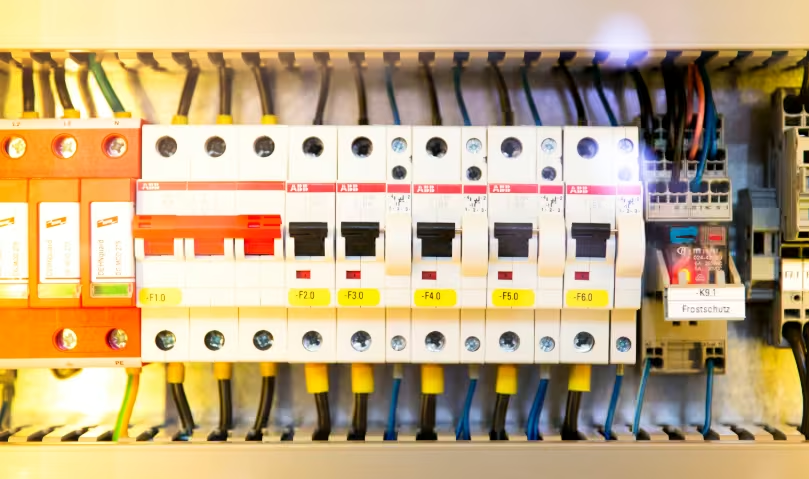
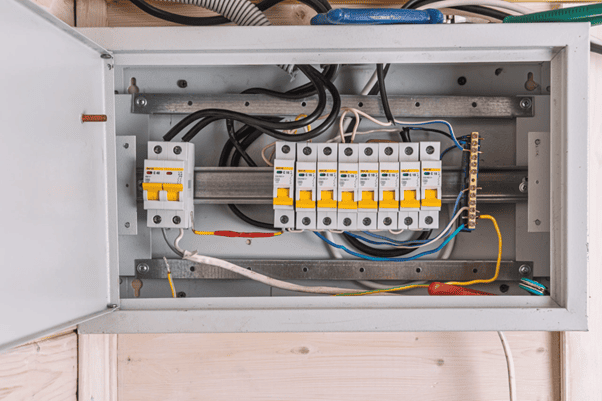
Four or five components, doing four or five different jobs. Worth knowing them by sight, because they each tell you something different when they misbehave.
The main switch cuts power to the whole house. One switch, usually at the top or one end of the board, often larger than the rest. If you ever need to kill power in a hurry, water leak near a power point, or smoke from an appliance, this is the one you flip.
Circuit breakers (MCBs) are the row of smaller switches that handle individual circuits: kitchen power, bedroom lights, the oven, and the hot water unit. When a circuit draws too much current, usually because something’s overloaded or faulted, the breaker trips and cuts power to that circuit only. Reset is a simple flick once the cause is sorted. If you’re finding one of these keeps tripping with no obvious cause, that’s usually the board or the circuit itself asking for attention.
RCDs (residual current devices) are safety switches. Different job for a circuit breaker. A breaker protects the wiring; an RCD protects the person. It watches the current flowing out on the active and back on the neutral, and if those two don’t match, because current is leaking somewhere it shouldn’t, like through a person touching a faulted appliance, it cuts power in under 30 milliseconds. That’s the difference between a bad day and a funeral.
RCBOs combine both functions on one module: circuit breaker and RCD in the same device, protecting one circuit. Modern boards increasingly use an RCBO per circuit rather than grouping several circuits under one RCD. It’s a better setup; if one circuit faults, only that circuit drops out, not half the house.
The meter measures what you use. In most Canberra homes, it now sits beside or inside the switchboard enclosure. Newer digital meters from Evoenergy replace the old spinning-disc meters you’ll still see on some older properties. The meter isn’t something you touch or reset; it’s the network’s, not yours.
That’s the whole board, in practical terms. Everything else is wiring and labelling.
What the labels mean (and why yours are probably wrong)
Each circuit breaker or RCBO controls a specific part of your home, and the label next to it tells you which. In a well-kept board, the labels are legible, accurate, and match what actually runs off each circuit.
In most older Canberra homes, they don’t.
What we typically see on callouts: a board labelled in biro in 1987, a kitchen renovation in 2004 that added two new circuits with no corresponding label update, a pergola put on in 2015 that’s now sharing a circuit with the laundry for reasons nobody remembers. The labels are a record of what the board used to control, not what it controls now.
Common labels worth knowing:
- Main / Main Switch — controls everything downstream.
- Lights (sometimes by area: “Bed Lights,” “Kitchen Lights”) — lighting circuits, typically 10A.
- Power or GPO — general power outlets, typically 16A or 20A.
- Oven / Cooktop / Hot Water / Air Con — dedicated circuits for fixed appliances, usually higher current.
- RCD or Safety Switch — covers multiple circuits downstream. If a board has one RCD labelled “Power” and everything else runs through MCBs only, your lights probably aren’t RCD-protected.
- Spare — a breaker installed but not connected to a circuit, left for future work.
If you can’t work out which switch controls what, don’t play guess-the-breaker by flipping them during a storm. A proper relabel during any switchboard or power repair is a five-minute add-on, and it makes every future fault ten times easier to diagnose.
The signs your switchboard is overdue for an upgrade
Not every old board is dangerous tomorrow. But some signs mean the board is telling you something, and they’re worth knowing. A few of them overlap with the broader warning signs of an electrical fire risk, which is why the board is almost always the first place we check.
Ceramic fuses or rewirable fuses. If you’ve got porcelain fuse holders with wire inside, you’re running technology from before the moon landing. Fuses protect the wiring from overload, but they don’t protect people from shock, and the wire inside can be, and often has been, replaced with whatever gauge was in the drawer. That’s not protection. That’s a gamble.
No RCDs anywhere on the board. If nothing is labelled “RCD” or “Safety Switch” and you don’t see a test button anywhere on the board, your home has no shock protection at the switchboard level. Under current wiring rules, that’s a gap.
Breakers that trip for no obvious reason. A healthy breaker trips because something is genuinely overloaded or faulted. If one keeps tripping with nothing meaningful plugged in, the breaker itself might be degraded, or there’s a fault somewhere in the circuit. Either way, it’s a call-out, not a reset-and-forget.
A breaker that won’t reset. If a tripped breaker won’t stay in the on position, don’t force it. That’s the board telling you the fault is still live. Leave it off and get a sparky out.
Buzzing, humming, or a warm board. A switchboard shouldn’t make noise or feel warm. Both mean a loose connection or a component under stress. Loose connections in a switchboard cause arcing, and arcing is how electrical fires start.
A burning smell, scorch marks, or discoloured plastic. Stop. Main switch off if it’s safe to reach. This is emergency electrical territory, not an inspection-next-week situation.
Flickering lights across multiple circuits. One flickering globe is a globe. Flickering across rooms, especially when appliances start up, usually points to a voltage issue at the board or service mains.
What AS/NZS 3000:2018 requires (and why most older Canberra boards fall short)
AS/NZS 3000 is the Australian/New Zealand Wiring Rules, the standard every electrician works to. The 2018 amendment brought in a change that matters for every homeowner: all final subcircuits in a new installation must have RCD protection.
“Final subcircuit” means every circuit that ends at a power point, a light, or a fixed appliance. That’s essentially every circuit in the house. Before 2018, it was common to protect only the power circuits and leave lighting unprotected. Under the current rules, lighting needs RCD coverage too.
This doesn’t mean every older board is illegal. the standard applies to new installations and significant alterations, not to retrospectively forcing every existing home to upgrade. But when work is done on an older board, adding a circuit for an EV charger, installing ducted reverse-cycle, or a kitchen renovation, the upgraded portion needs to meet the current standard. In practice, that often means the board itself has to come up to scratch, because you can’t add a compliant new circuit to a board that can’t support it.
This is also where a switchboard upgrade for EV charging or a move to three-phase power tends to come into the conversation, not because anyone’s forcing it, but because the new load is what pushes the old board past its limit.
Most Canberra homes built before 2018 will have partial RCD coverage at best. Homes with ceramic or rewirable fuses have none. Knowing where your board sits on that spectrum is most of the conversation about whether an upgrade is due.
Why switchboard work in the ACT is notifiable
Three reasons this matters, and one of them isn’t obvious.
First, electrical work in the ACT is licensed. Unlike some trades, there’s no DIY exemption for switchboard work, not for homeowners, not for handymen. Access Canberra regulates electrical licensing under the Electricity Safety Act 1971 and related legislation, and the Utilities Act 2000 governs how licensed work connects to the network. It’s one of the reasons electrical safety in Canberra sits under a stricter regulatory regime than most people realise.
Second, switchboard upgrades usually require coordination with Evoenergy, the ACT’s electricity network distributor. If the service mains need to be disconnected to do the job safely, that’s a network-side operation. Evoenergy pulls the service fuse, the electrician does the work, and Evoenergy reconnects. It’s not something that happens on the customer side of the meter alone.
Third, and this is the one most people miss, any electrical work done in the ACT must be certified. A licensed electrician issues a Certificate of Electrical Safety once the work is inspected and signed off. That certificate is what your home insurer will ask for if something goes wrong. Unlicensed work, even if it looks fine, can void your insurance if a fault is later traced back to it.
For a switchboard upgrade in Canberra, that means: licensed electrician, Evoenergy coordination where required, certificate issued at completion. Nothing optional about any of it.
When a reset is fine, and when it’s telling you something bigger
A circuit breaker trips. You walk to the board, find the one that’s in the off (or middle) position, flick it fully off and then back on. Power’s back. That’s a reset, and in most cases it’s completely fine. You overloaded a circuit, the breaker did its job, and now you move on.
When a reset is fine: the breaker tripped once, you can point to the reason (hairdryer plus heater plus kettle on the same circuit, or a single faulty appliance you can unplug), and it stays reset after.
When a reset isn’t the answer:
- It trips again the moment you flick it back on.
- You’ve unplugged everything on that circuit, and it still won’t hold.
- Two or three breakers drop out together.
- There’s a smell with it, or a scorch mark, or a humming sound from the board.
- The RCD trips, you unplug the lot, and it still won’t reset.
Any of that means the fault’s still live. Every time you reset a breaker that’s tripping on a real fault, the cable heats up. Do it enough times, and the insulation starts to break down inside the wall, where you can’t see it. By the time it shows up, you’re past the point of a simple repair. That’s when you stop resetting and call a licensed electrician for repairs instead.
Book a switchboard inspection
Ceramic fuses on the board. No RCDs anywhere. A breaker that keeps tripping for reasons nobody can explain. Labels that haven’t matched the house since the last kitchen reno. Any of these, and it’s time to get a licensed electrician in.
An inspection tells you what you’ve actually got, the age of the board, where it sits against the current wiring rules, and whether an upgrade is due or whether it’s fine for another few years. No pressure either way. Most boards we look at fall somewhere in between.
Watts Needed has been on Canberra switchboards for over 40 years. Based in Monash, across every suburb from Ainslie to Denman Prospect, 24/7 for emergencies. Get in touch or call 0440 138 246.