Electrical wire colours Australia explained by a Canberra electrician, current AS/NZS 3000 codes, old colours, and what to watch for in older homes. Reach out to learn more.
Open a power point in a 1960s Ainslie home, and you’ll see red, black, and green. Open one in a 2019 build-out in Wright, and it’s brown, blue, and green-yellow. Same house current. Same job. Different decade, different colours, and anyone who doesn’t know the difference is one wrong assumption away from a serious shock.
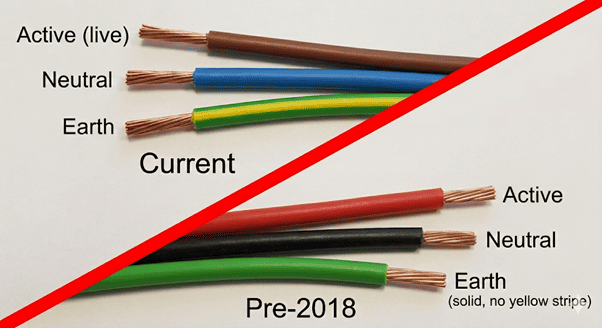
That split comes down to when the house was wired. The electrical wire colours Australia uses now come from AS/NZS 3000:2018, brown for active, blue for neutral, and green-and-yellow stripe for earth. Pre-2000 wiring runs the old code: red, black, and plain green, doing the same three jobs with different colours on the outside. Both systems are legal. Both are safe when the cable underneath is intact. The trouble starts where they meet.
Key takeaways
- Under AS/NZS 3000:2018, single-phase wiring uses brown (active), blue (neutral), and green-and-yellow earth.
- Pre-2000 homes still run on the old code, red, black, and plain green.
- Three-phase adds brown, black, and grey for phases 1, 2, and 3, with blue neutral and green-and-yellow earth.
- The trap: black was neutral in the old single-phase code. Black is a live phase conductor in the new three-phase code. Same colour, opposite role.
- Old colour wiring is legal and safe if the cables are in good nick. Any new work in the ACT, a fresh circuit, a switchboard upgrade, an extension, has to meet current AS/NZS 3000 colours.
- Fixed electrical work in the ACT needs a licensed electrician. That’s the rule under the Construction Occupations (Licensing) Act 2004.
What are the current electrical wire colours in Australia?
AS/NZS 3000:2018 is the current edition of the Australian Wiring Rules. Every licensed electrician in the country works on it. In a standard single-phase domestic circuit, three wires do the work:
- Active (live): brown
- Neutral: blue
- Earth: green with a yellow stripe
That’s it for 99% of what you’ll see inside a Canberra home built from the early 2000s onward. The active wire carries current from the switchboard to the power point or light fitting. The neutral completes the circuit and returns current to the source. The earth is the safety conductor; if something faults, it gives the current a low-resistance path to ground rather than through you or your appliance.
The electrical wiring colour code Australia runs on is designed so that any licensed electrician, anywhere in the country, can open a wall cavity and read the circuit in seconds. That matters more than most people realise, especially in a city like Canberra, where housing stock spans almost every decade since the 1920s.
Why did Australia change its wiring colour code?
The change wasn’t cosmetic. It was about aligning with international practice.
Before the shift, Australia had its own colour system, red, black, green, which didn’t match what was coming in on imported appliances, extension leads, or the cables used in most of Europe and the UK. That’s a problem when you’ve got a Bunnings-bought lamp with brown/blue flex wired into a house with red/black fixed cabling. Two different systems, one junction box, plenty of room for error.
Around 2000, Australia moved to the IEC 60446 colour scheme, brown, blue, green-yellow, to bring fixed wiring into line with flexible cord and international gear. The 2018 edition of AS/NZS 3000 reinforced that standard and clarified the rules for mixed installations. Homes wired since then all follow the new code.
One thing worth noting: the old wiring colours Australia used are not dangerous in themselves. A red active from 1975 still carries the current in the same way a brown active from 2020 does. The risk sits at the join between the two, which brings us to the next section.
Old wiring colours in Australia: what you’ll see in older homes
If your place was built before about 2000 and hasn’t been rewired, the pre-2018 colours, or more accurately, pre-2000 colours, are what you’ll find behind the walls.
Single-phase pre-2018 wiring colours:
- Active: red
- Neutral: black
- Earth: green (solid, no yellow stripe)
Open the switchboard of an original-build home in O’Connor or Lyons, and red-black-green is what you’ll see behind the cover. What trips people up is partial rewires, a new kitchen circuit run in brown and blue, feeding back to a switchboard still full of the old colours. One house, two codes, and a join somewhere in between.
Are old wiring colours still safe? If the cable’s intact, yes. Colour doesn’t degrade with age. Insulation does. In homes from the 60s and 70s, what usually fails is the sheath, rubber-insulated wiring that’s gone brittle and cracks when you flex it, or vulcanised India rubber (VIR), crumbling where it terminates at the switchboard. Cotton-braided cable around old ceiling roses is sneakier: the braid looks fine from the outside, but the conductor inside is often exposed. Colour tells you the era. The cable tells you the condition.
The other reason to take old colours seriously is renovation. If you’re adding a new circuit, extending a run, or upgrading the switchboard, the new work has to be in current colours. That means a competent electrician has to correctly identify what’s what at the join, and that’s where the black wire problem comes in.
Three-phase wiring colours Australia: what’s different
Three-phase power is what bigger homes, workshops, commercial buildings, and properties with serious loads run on. Not every Canberra home has it, but anyone with a ducted reverse-cycle, EV charging at scale, a workshop, or a larger rural-block setup around Tharwa or Hall might.
Current three-phase wiring colours under AS/NZS 3000:2018:
- Phase 1 (L1): brown
- Phase 2 (L2): black
- Phase 3 (L3): grey
- Neutral: blue
- Earth: green-and-yellow
Old three-phase wiring colours, pre-2000:
- Phase 1: red
- Phase 2: white
- Phase 3: blue
- Neutral: black
- Earth: green
Each phase is offset 120 degrees from the next. That’s what gives three-phase its smoother, more balanced power delivery, useful for motors, EV chargers, ducted reverse-cycle, and anything drawing serious current. Worth stressing for anyone looking at a three-phase circuit: all three phase wires are live. None is neutral, and none is safer to grab than the others.
The black wire problem: where old and new wiring turn dangerous
This is the part most quick-reference blogs skip over. It’s also the single most important thing a homeowner in Canberra should know.
Black was the neutral wire in the old single-phase system. Black is a live phase wire (Phase 2) in the current three-phase system.
Same colour. Completely different role. Different era.
That crossover is where real harm happens. A homeowner sees black and assumes it’s neutral because they’ve read that somewhere online, but if the house has been partially rewired, or if the circuit they’re looking at is actually a three-phase feed, that black wire is sitting at 240V. White in the old three-phase system was the same trap: it’s a live phase, not a neutral.
What we see in practice on older Canberra jobs is mixed wiring, original 1970s single-phase running the lighting circuits, a newer sub-main added for an extension, and sometimes a three-phase upgrade for the switchboard. All in one house. All in different colours. Every active part in the place has to be traced, labelled, and tested before anyone touches anything, and that’s not a job for guesswork.
What this means for older Canberra homes
A lot of the inner-north stock, Ainslie and O’Connor especially, is still running on wiring that should’ve been replaced twenty years ago. Original switchboards, original circuits, often no safety switch on the main.
If your wiring predates the 2000s changeover, a few practical checks are worth doing:
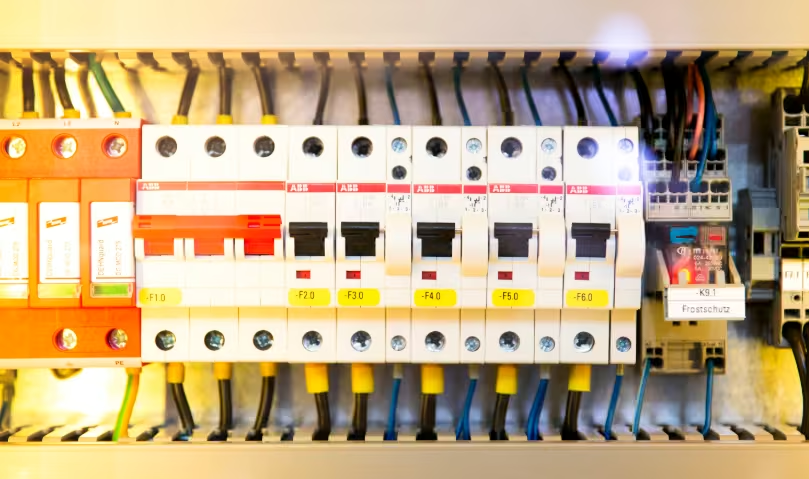
- Ceramic fuses in the board point to pre-1990 wiring behind it. Not automatic, some have been patched over the years, but it’s a fair starting assumption.
- Check for a safety switch (RCD) on the main. Older boards often don’t have one, and in the ACT, any switchboard work now triggers RCD installation as a compliance point.
- Note any flickering lights, warm power points, or breakers that trip when the heater comes on. Canberra winters put a heavy load on older circuits, reverse-cycle running 12+ hours a day, oil heaters, and electric hot water. That’s when tired wiring shows up.
Not every older home needs a full rewire. A switchboard upgrade on its own clears up most of the old/new colour confusion at the consumer end. It also gets the house onto current AS/NZS 3000 without a full rewire, which for most older Canberra homes is the sensible middle ground.
Is DIY electrical work legal in Australia?
No, and not just as a technicality. In the ACT, only a licensed electrician can legally do fixed wiring work. That’s under the Construction Occupations (Licensing) Act 2004, with Access Canberra running the licensing side. Penalties for unlicensed electrical work run into tens of thousands of dollars, and insurance claims on damage or injury caused by DIY wiring usually don’t get paid out.
Understanding the colours isn’t about doing the job yourself. It’s about knowing what you’re looking at before you call someone who can.
Talk to a licensed Canberra electrician
If you’ve opened something up and you’re not sure what you’re looking at, or you’ve got a mix of old and new wiring and want a straight answer on whether it’s safe, book a site inspection with Watts Needed. We work across Canberra on everything from single-circuit repairs to full switchboard upgrades in pre-2000 homes.