USB powerpoints are worth installing in specific locations, bedside tables, home office desks, and kitchen benches where daily device charging is routine. They’re not the right upgrade for every GPO in your home, and they won’t replace a quality wall adapter for laptop charging. Here’s what a Canberra electrician would tell you before you commit.
What Is a USB Power Supply and How Does It Work?
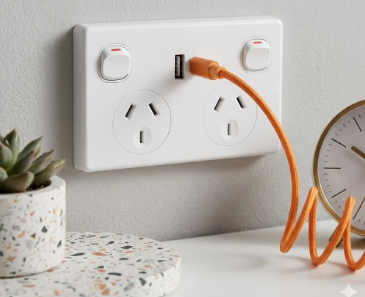
A USB power outlet replaces a standard double GPO with one that has built-in USB charging ports alongside the regular 240V outlets. The USB ports draw power directly from your home’s wiring and step it down to a device-safe voltage. no wall adapter needed.
Most models keep both standard outlets and add one or two USB ports next to them. The Clipsal Iconic, which is the most widely installed unit in Australia, pairs a USB-A port (2.4A) with a USB-C port (3.0A). You can charge two devices at once while keeping the regular outlets free.
What’s the Difference Between USB-A and USB-C Powerpoints?
USB-A is the older rectangular connector that’s been standard since the late 1990s. It delivers up to 2.4A, enough for phones, smart watches, Bluetooth speakers, and accessories that don’t need fast charging.
USB-C arrived as the standard for a reason. It’s reversible, faster, and now ships with virtually every device made after 2022, iPhones, Android phones, iPads, and most laptops. Wall-mounted USB-C ports typically deliver between 3A and 25W, with higher-end units like the Legrand Excel Life pushing to 60W for desk setups where laptop charging is part of the picture.
If your household is primarily running newer devices, USB-C is the port that will carry most of the load. USB-A handles the older kit, legacy tablets, kids’ devices, accessories.
A dual-port unit with one of each covers most households comfortably. It’s the configuration we’d recommend as a starting point for any Canberra home.
Are USB Powerpoints Actually Worth It?
Yes, in the right locations and with realistic expectations about what they can do.
Bedside tables are the strongest use case. You charge every night, usually overnight, where charging speed barely matters. The Clipsal Iconic fits flush into a standard GPO cutout, looks intentional rather than makeshift, and keeps both standard outlets free for the lamp and anything else on the bedside. For this application specifically, a USB power outlet outperforms a power board in every way that matters.
Home office desks are the second strongest case, particularly in Canberra, where a high proportion of households include someone working from home full or part of the week. Charging a phone, tablet, and a set of earbuds throughout a working day without a knot of adapters sitting on the desk is a genuine improvement. It’s also tidier when you’re on a video call.
Fast-charging a laptop at full speed is where the expectation needs adjusting. Most standard USB-C wall ports cap out at 25W. A modern laptop typically needs 45W to 65W to charge at full rate under AS/NZS 3000:2018 electrical standards for continuous load. It will charge, just slowly. If laptop charging speed is the priority, a quality GaN plug-in adapter delivers better performance at a fraction of the installation effort.
The other thing worth knowing: USB powerpoints are unswitched. The USB ports can’t be turned off at the wall plate. That concerns some people. In practice, most find it irrelevant.
USB Powerpoint vs Power Board: Which Is the Better Option?
The answer depends on whether permanence and aesthetics matter to you.
A quality USB power board, an HPM or Belkin unit with built-in USB-C, charges just as fast, takes no installation, and can be swapped out when USB technology evolves. For households where flexibility matters more than presentation, that’s a rational choice.
A flush-mounted USB power outlet is a different proposition. A power board on a bedside table or kitchen bench looks like a problem being managed. A wall-mounted unit looks like part of the house. There’s no cable to fray, no adaptor sitting in a socket blocking the outlet beside it, and nothing to knock off a surface. It’s a permanent infrastructure.
There’s also a safety angle. During electrical maintenance work in Canberra homes, the most common hazard we encounter isn’t the wiring itself, it’s a single powerpoint overwhelmed with power boards, and adapters daisy-chained together. USB powerpoints reduce that load. They’re a neater solution and a lower-risk one.
The honest comparison: if you’re renovating, building, or simply care about how a room presents, the wall-mounted option is worth it. If you need flexibility or don’t want to involve an electrician, a quality power board is a perfectly sensible alternative. Neither answer is wrong.
Where Should You Install USB Powerpoints in Your Home?
Not every GPO benefits from a USB upgrade. Most don’t. The locations that make practical sense:
Bedside tables — You’re charging something there every night, usually next to a lamp that’s already using the outlet. The case here is straightforward.
Home office desks — Canberra has a high density of public servants, consultants, and remote workers. A desk that handles daily device charging without adapter clutter pays off across a full working week.
Kitchen bench — worth it if a tablet for recipes or a phone stays there consistently. Less compelling if the bench is primarily used for appliances.
Living room entertainment unit — useful if remotes, game controllers, or earbuds are being charged regularly in one spot.
Hallways, laundries, and garages — rarely worth it. The daily charging habit isn’t there, and the installation effort doesn’t match the return.
One practical consideration that often goes unmentioned: USB powerpoints have bulkier backs than standard GPOs, typically 40–50mm deep. Most standard gyprock walls accommodate this without issue. Older Canberra homes, particularly those in Belconnen or Tuggeranong, built through the 1970s and 1980s, can have shallower plasterwork or pre-cut tile splashbacks that need checking. Worth raising before the job is booked.
Does Installing a USB power outlet require a Licensed Electrician in Canberra?
Yes. All powerpoint work in the ACT must be carried out by a licensed electrician for safety reasons, and that includes replacing a standard GPO with a USB model.
This isn’t a technicality. AS/NZS 3000:2018, which governs electrical wiring rules in Australia, sets the standard for any fixed electrical installation, and ACT licensing requirements sit on top of that. DIY installation isn’t just a fine risk; it can void your home insurance policy if something goes wrong and an unlicensed installation is discovered.
It’s also worth being specific about what goes into the wall. Not every USB power outlet sold online has been tested and certified to Australian standards under AS/NZS 3112. No-brand units from international marketplaces regularly fall short. Clipsal and Legrand supply through licensed trade channels for a reason: the certification process is part of what you’re paying for.
Watts Needed covers USB powerpoint installations across Canberra. If you’re not sure whether your walls can take the unit you’ve been looking at, raise it when you call. We can check it on the same job.
Which USB Powerpoint Is the Best Choice for Australian Homes?
For most Canberra households, the Clipsal Iconic dual USB-A/C is the right starting point. It fits standard GPO cutouts without modification, the Iconic Series faceplate swaps easily across finishes (white, black, and several Iconic range options), and the combination of 2.4A USB-A and 3.0A USB-C covers the vast majority of household devices. It’s also the most commonly installed unit across Australia, which matters for parts availability if anything ever needs attention.
For desk setups where laptop charging is part of the picture, the Legrand Excel Life 60W USB-C is worth considering. It delivers meaningful power delivery for MacBooks and USB-C laptops, comes in white or black, and sits flush in a standard plate. It’s a more expensive unit than the Clipsal, and better suited to a specific application than general household use.
The units to avoid are no-brand options from online marketplaces. Australian electrical standards under AS/NZS 3112 are specific about what’s certified for fixed installation. Units that haven’t been tested to those standards aren’t worth the savings, particularly once they’re in the wall and not easily visible.
Watts Needed Electrical is a family-owned business based in Googong, with over 40 years of combined experience across residential and commercial electrical work in Canberra and the surrounding region. If you’ve been weighing up whether USB powerpoints are worth it for your home or workplace, our team can give you a straight answer, no obligation, no upselling, just an honest assessment of what makes sense for your setup. Contact us