In short
- Most Canberra EVs charge fine overnight on a standard powerpoint. A dedicated charger is about speed and long-term safety, not survival.
- A 7kW single-phase home EV charger installation typically runs $1,500 to $3,000 fully installed. Three-phase or a long cable run pushes that higher.
- Your switchboard decides whether this job is simple or expensive, not the brand of charger you pick.
- The ACT Sustainable Household Scheme can fund the charger, the installation, and a three-phase upgrade through one loan.
- Apartments and strata need a sign-off before any of this starts.
A home EV charger installation in Canberra typically costs somewhere between $1,500 and $3,000 fully installed for a standard 7kW single-phase unit, more if your switchboard needs work first or if you’re going three-phase. That number matters more than any charger’s marketing copy. Before comparing units, get clear on three things: whether you need a dedicated charger at all, what your switchboard can actually carry, and what the ACT Sustainable Household Scheme will fund. This guide runs through all three, plus the real difference between a 7kW and a three-phase EV charger, when a smart or solar EV charger earns its price tag, and what a proper quote should itemise before you sign anything.
Do you actually need a home charger?
Honestly? Maybe not yet.
The ACT Government’s own figures put the average Canberra driver at around 38 kilometres a day. A standard 10A powerpoint will take most EVs from empty to full in 15 to 30 hours, depending on the battery. Plug in after dinner, unplug before work, and for a lot of households that’s the entire charging routine sorted, no installation required.
Where it changes is volume and safety. If you’re driving long distances regularly, running two EVs off one house, or you just don’t want a car cable running across the garage floor every night for the next ten years, that’s when a proper installation starts paying for itself. There’s also a wear factor: a standard socket wasn’t built for a sustained 10-hour draw every single night, and older Canberra homes weren’t wired with that kind of continuous load in mind.
10A, 15A, or a dedicated home EV charger installation?
A 10A or 15A socket is fine for occasional top-ups. A dedicated home EV charger installation is what you want if you’re charging daily, long-term, or you’d rather not find out the hard way what a decade of nightly high-draw charging does to a general-purpose outlet.
The difference isn’t really about speed, though a dedicated unit is faster. It’s about the circuit being built for the job: its own breaker, its own RCD protection, sized cable, and a connection point rated for hours of continuous current rather than the odd kettle boil. In a lot of older Canberra houses, that general power circuit is already carrying more than its original designer ever planned for. Adding a car to it isn’t a great long-term bet.
What a home EV charger installation costs in Canberra
$1,500 to $3,000 fully installed. That’s the realistic EV charger installation cost in Canberra for a standard 7kW home EV charger installation, assuming the switchboard doesn’t need work first, and it’s where most quotes we write land. Go three-phase, or run a long cable from the switchboard to the parking spot, and the number moves. Three-phase gear costs more on its own. A longer run adds conduit and labour hours on top of that. Put the two together and jobs commonly land at $4,000 to $5,000, occasionally more on a genuinely awkward site. None of that gap is padding; it’s what the extra materials and time actually cost.
Three things move that number:
- The unit itself. A basic wall-mounted charger starts under $1,000; a smart EV charger with app control and solar integration usually sits between $1,800 and $2,500.
- Cable distance. Every extra metre between your switchboard and where you park adds to the labour cost, particularly for a three-phase EV charger where the cable itself costs more.
- Switchboard condition. A meaningful share of Canberra homes need some switchboard work before a charger can go in at all, and that’s a separate line item, not part of the charger’s price tag.
Once installed, the ongoing savings from charging at home instead of relying on public chargers are where the real value compounds over the life of the car.
Check your switchboard before you buy anything
This is the step that decides whether your job is straightforward or expensive, and it has nothing to do with which charger you’ve picked.
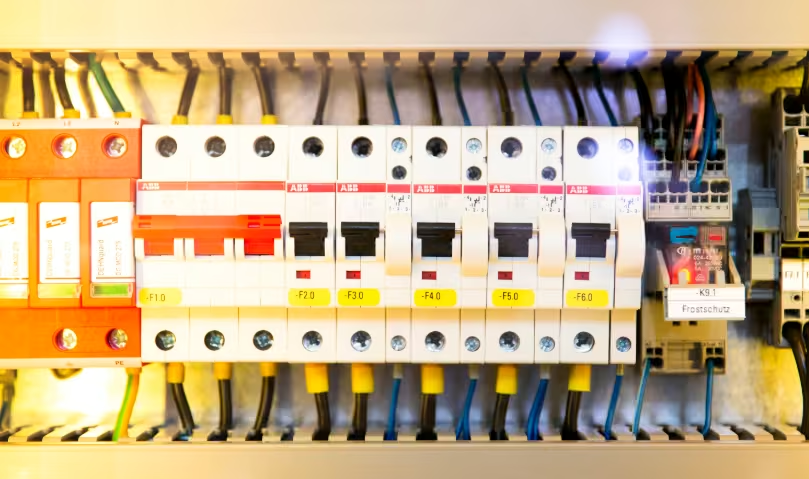
A lot of Canberra’s older housing stock, think Ainslie, Campbell, Red Hill, and similar-era suburbs, was wired for a house, not a car. Ceramic fuses, no safety switches, cabling sized for lighting and small appliances. Trying to add a 7kW load onto that setup isn’t a matter of “will it work”; it’s a matter of “what fails first.” AS/NZS 3000 sets out what a circuit like this actually needs: dedicated wiring, correct RCD protection, adequate switchboard capacity, and a licensed electrician has to sign off on it either way, so it’s worth knowing before you fall in love with a specific charger. This is common enough in Canberra’s older suburbs that a switchboard upgrade for EV charging often ends up on the quote before the charger itself does.
If you’re not sure where your switchboard stands, that’s exactly what a site visit is for.
Single phase or three phase, and how to tell which you have
Open your switchboard and count the main switches. One switch, one incoming cable, that’s single-phase, and it’s what runs most Canberra homes. Three switches, or a visibly heavier set of incoming cables, means three-phase, which is less common in established suburbs than most people assume. If you’re not confident reading it yourself, it’s a five-minute check for an electrician during a quote.
Capacity is where the two split. A single-phase EV charger tops out at 7kW, plenty for a full overnight charge on nearly any commute. Three-phase opens the door to an 11kW or 22kW EV charger, but usually only in houses where three-phase was already run for something else, like a workshop or a larger air conditioning system, not installed specifically for a car.
A three-phase upgrade in the ACT can run up to $6,000, sometimes less if the supply is close by, sometimes more on a difficult site. For most households, the honest advice is: skip it. A 7kW single-phase EV charger handles the vast majority of daily driving on its own, and three-phase only earns its cost when it’s already planned for something bigger than the car, like a workshop, a larger solar setup, or three-phase appliances. The ACT Sustainable Household Scheme loan can cover this upgrade too, provided it’s tied to an eligible product like the charger itself.
Choosing the charger: 7kW vs 11kW, tethered vs untethered, Type 2, smart features
Output
A 7kW EV charger is the ceiling for single-phase homes. That’s still enough to fully charge an EV overnight, covering commutes well beyond Canberra’s daily average. An 11kW or 22kW three-phase EV charger is the alternative in properties with three-phase already connected, usually installed originally for a workshop, ducted air conditioning, or solar.
Tethered vs untethered
A tethered charger has the cable built in, so you grab it and plug in, no separate lead to manage. An untethered EV charger just has a socket, so you carry your own cable. Untethered units are marginally more flexible if you ever change vehicles or connector types, but most Canberra households find tethered simpler day to day.
Connector
Nearly every EV sold in Australia uses a Type 2 connector, so a Type 2 electric car charger is the safe default unless you’re dealing with an older or imported vehicle.
Smart features
A smart EV charger adds app-based scheduling, usage tracking, and off-peak automation. Look for one that’s OCPP EV charger compatible. Open Charge Point Protocol means you’re not locked into one manufacturer’s app if you switch energy retailers or want a different platform down the track. Units like the myenergi Zappi, Fronius Wattpilot, and Wallbox Pulsar Plus are common in the Canberra market and cover most of this ground between them.
Solar, load management, and off-peak charging
If you’ve already got solar, a solar EV charger is where the real long-term saving shows up. Not in the install cost, but in what you’re not paying ActewAGL for over the following ten years.
A solar-aware charger monitors your system’s output and automatically diverts excess solar generation into the car instead of exporting it for a few cents a kilowatt-hour. Pair that with an off-peak charging schedule for the nights solar isn’t enough, and most households end up charging the bulk of their driving for close to nothing. Load management is worth asking about too, particularly in older homes: it stops the charger and, say, ducted air conditioning from drawing on the switchboard at the same time and tripping the circuit breaker.
ACT Sustainable Household Scheme: what’s covered
The Sustainable Household Scheme gives eligible ACT homeowners an interest-free loan covering the charger and its installation. A three-phase upgrade can go on the same loan if the job needs one. Repayments run over up to ten years. (Loan caps and eligibility have changed recently. Confirm current limits with Access Canberra or Climate Choices ACT before publishing, as figures here reflect settings that shift periodically.)
A few things worth knowing going in: the installation has to be done by an ACT-licensed electrician for the loan to apply, chargers above 7kW may require the three-phase upgrade to be bundled into the same application, and the scheme is administered through an approved lender rather than paid directly by the ACT Government. It’s a genuinely useful way to spread the cost to install an EV charger at home without paying it all upfront, but the fine print is worth reading rather than assuming.
Apartments and strata
Charging in an apartment or strata complex is possible, but it’s a different process to a standalone house, and it starts with the body corporate, not the electrician.
Most apartment switchboards and car park power aren’t set up for individual EV loads, so installing an EV charger at home in this context usually means either a dedicated metered connection run back to your unit, or in newer buildings, shared charging bay infrastructure the strata scheme manages centrally. Either way, you’ll need sign-off before any work starts: building consent, and sometimes a specific electrical assessment of the shared switchboard’s spare capacity. It’s more paperwork than a house, but it’s not a dead end.
What a proper quote should itemise
A proper quote for a home EV charger installation should break into clear parts, not arrive as one bundled number with no explanation of what’s in it.
At minimum, that’s: the charger unit itself, the cable run and any conduit work, switchboard work if your board needs it, and the compliance testing and certificate that comes with any notifiable electrical work in the ACT. A site visit is what makes this accurate rather than a guess. It’s the only way to actually see your switchboard, measure the cable run, and confirm single or three-phase before committing to a number. If a quote skips that step, it’s an estimate, not a quote.
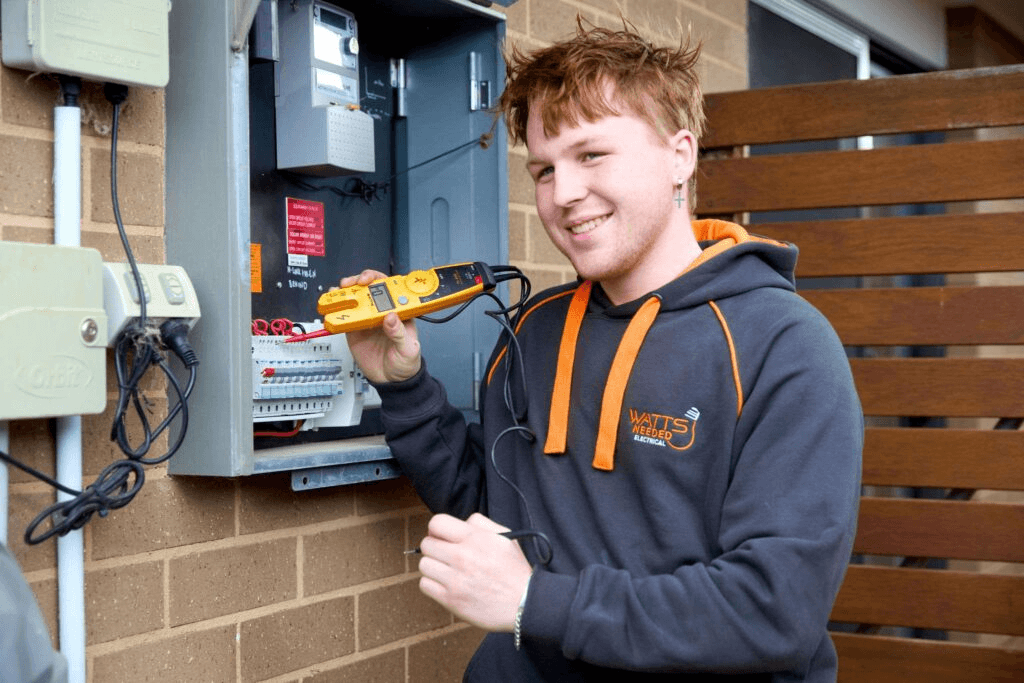
If you’re trying to work out what a home EV charger installation actually looks like for your specific switchboard, that’s what a site visit is for. Get in touch with Watts Needed and you’ll get an itemised quote, not a number guessed over the phone.
FAQ
A single-phase home EV charger installation with no switchboard work needed is typically a one-day job: one electrician, one visit, the charger commissioned before they leave. A switchboard upgrade changes that timeline. Budget for two separate visits, since the upgraded switchboard has to be tested and certified before the charger circuit gets connected to it.
No. The circuit feeding an EV charger is notifiable electrical work under the Utilities Act and AS/NZS 3000, meaning only a licensed electrician can carry it out and issue the compliance certificate. Without that certificate, a home insurer can decline a claim connected to the installation, and the charger won't qualify for ACT Sustainable Household Scheme funding.
A 7kW EV charger is the single-phase option. An 11kW unit is the three-phase alternative. Most Canberra homes only have single-phase power connected. That's usually what decides the choice, not the charger specs themselves.
Not really. The best home EV charger in Australia depends on your power supply, your car's onboard charger limit, and whether you want smart or solar features. A 7kW smart unit with a Type 2 connector covers the large majority of Canberra households.
Scheduling, solar integration, and usage tracking are the real value in a smart EV charger, worth paying for if you'll actually use them day to day. OCPP compatibility is a separate consideration: it keeps the hardware independent of any single app or energy retailer, so switching providers later doesn't mean replacing the charger.
The main switch at your switchboard is the simplest indicator. A single incoming cable and one main switch point to single-phase power, which covers most Canberra properties. Three main switches, or a visibly heavier set of incoming cables, point to three-phase power instead. Confirming which supply type is connected is straightforward for an electrician to check during a standard quote visit, though it can be harder to read correctly without training if the switchboard is old or has been modified over the years.
Yes. EV charging infrastructure and its installation is its own eligible category under the scheme, separate from financing the vehicle.
Usually, but it needs body corporate approval first and often a dedicated metered circuit rather than tapping into shared power. It's a longer process than a standalone house, not an impossible one.