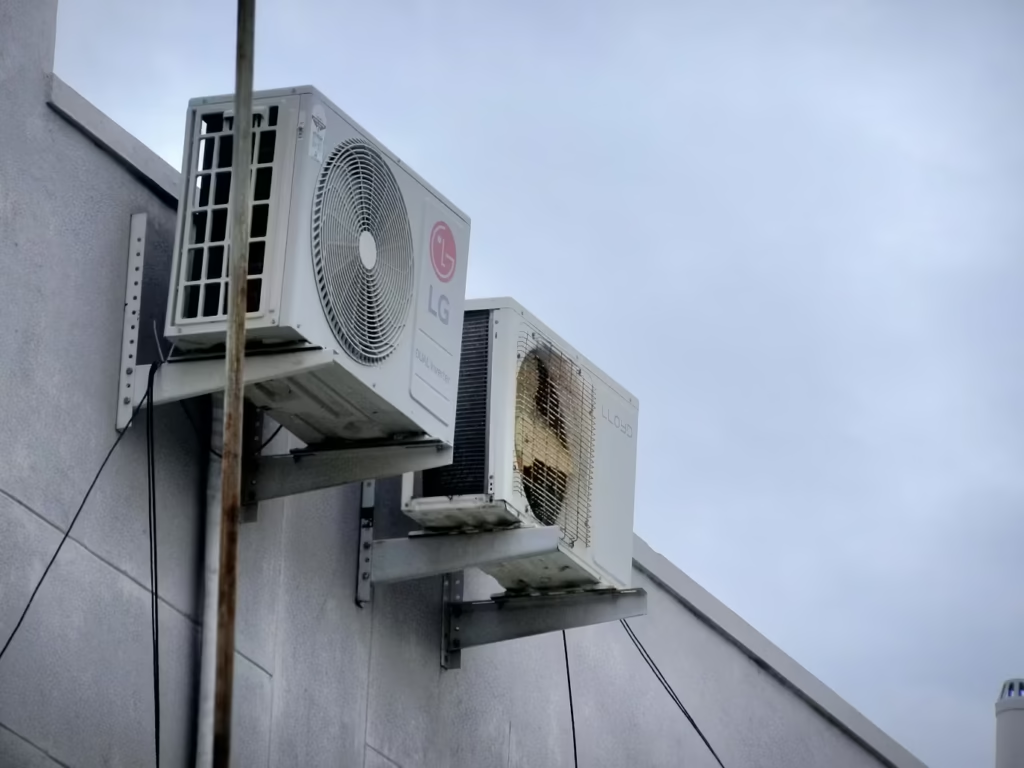

What size air conditioner you need comes down to one ratio: 0.125 to 0.15kW per square metre of floor, on a 2.4m ceiling. A 6 by 3 bedroom is 18m², so 2.7kW. Nobody makes a 2.7. You’d fit the 3.5 and take the margin, because a 2.5 in that room spends every February running flat out and still losing ground by mid-afternoon. Room-by-room figures are in the table below.
That ratio is what sits behind every online calculator. It’s also where all of them stop. None ask what the unit has to do in July, and in Canberra that’s the question that decides whether the sizing holds.
Key Takeaways
- Rule of thumb: around 0.125 to 0.15kW per square metre (2.4m ceiling) is a starting figure, not a final answer.
- Check the unit’s rated heating output at low outdoor temperatures before you check its cooling kW. This is the step Canberra buyers get caught by.
- Apartments and houses carry different heat loads at the same floor area. Shared walls change the maths.
- A calculator gets you into the right bracket. It won’t catch your glazing, your insulation, or your switchboard’s spare capacity. That needs someone on site.
Home vs Apartment: Does It Change the Number?
Floor area is only half of it. A chart treats every 20m² room as one thing, house or apartment, and they aren’t one thing.
The apartment case cuts both ways at once, which is what makes it awkward to size. A mid-level unit has one or two external walls and neighbours doing the insulating on the rest, so the chart figure is often generous by a bracket. Then you walk in and find floor-to-ceiling glass on the western side, a balcony door that’s effectively another window, and a slab that’s been absorbing sun since eleven that morning and will still be giving it back at eight that night. Two of those and the savings from the shared walls is gone. Three and you’re sizing up, not down. Newer Canberra builds are full of exactly that combination.
Older weatherboard and brick veneer, the 70s and 80s stock, is a simpler problem. Not much in the ceiling, single-pane glass, and a bracket more capacity than the square metres suggest.
How to Calculate Aircon Size
Measure the room’s length and width in metres, multiply them for the floor area, then run that number against the 0.125 to 0.15kW baseline above. From there, a few things push the figure up:
- a ceiling taller than 2.4m
- unshaded glass facing west or north
- an open-plan layout pulling in an adjoining kitchen or hallway
- a roof space with old or compressed insulation
Two or three of these together will usually shift the bracket up.
Is a “What Size AC Do I Need” Calculator Good Enough?
For a first pass, yes. It’ll get you within a bracket, which is enough to start with. What it can’t see is your ceiling, your windows, or which way the living room faces in July. Shortlist, not a purchase order.
How Many kW Aircon Do I Need?
A whole-house average is no use here. Two rooms can measure identical square metres and still want completely different gear, and the difference isn’t floor area at all. Bedroom: shaded half the day, two people in it at night. Living area: glass on two sides, and a kitchen throwing heat in from six onward.
Space | Approx. floor area | Typical capacity |
Single bedroom | 12–15m² | 2.0–2.5kW |
Bedroom / small living room | 15–20m² | 2.5–3.5kW |
Living room / open-plan kitchen-dining | 30–40m² | 5.0–7.0kW |
Whole-home ducted (3–4 bedroom) | 150–200m² | 14–18kW |
Figures assume standard insulation and a 2.4m ceiling.
What Size Air Conditioner for a Canberra House?
Same ratio as anywhere else, then more for the heating side. That second part is what separates a Canberra house from the same house in Sydney or Brisbane, and it’s the part the calculators leave out entirely.
Rated capacity on a reverse cycle unit is measured at 7°C outdoors. Canberra sits under that most mornings from June through August, so the 7kW printed on the box is a 7kW you get in April. Manufacturers do publish the low-temperature figures. They’re just sitting in the technical data sheet instead of the brochure, two or three pages in, and the fall-off toward -5°C is steeper than most buyers expect. Ask the supplier for that sheet. If they can’t produce it, that tells you something about what you’re being sold.
What size aircon for a 3-bedroom house in Canberra?
Call it 10 to 14kW on 130m². That’s a wide range for one house. What moves you across it is the system, not the building.
Multi-split ends up at the top of it. Three bedrooms at 2.5kW each, a 6 or 7kW head over the living and dining end, and you’re at 14 before anyone’s thought about the hallway. Every head sized for its own room. Every head able to run while the others sit idle. Ducted covers the same house on 10 or 12, because zoning means the compressor is never asked to serve the whole floor plan at once.
Neither one’s wrong. Multi-split gives you room-by-room control, and if a head dies you’ve lost one room rather than the house. Ducted runs quieter and costs less, assuming the zoning was set up properly. In plenty of homes it wasn’t.
What size reverse cycle for Canberra winter? Work backwards from the heating output rather than the cooling. A unit sold as 7kW might show 8kW heating on paper and deliver half of that at -3°C. Then there’s defrost. Every reverse cycle system runs a defrost cycle in cold weather, and that’s normal, but a unit dropping into it every twenty minutes on a July morning has been sized for a milder climate than the one it’s working in.
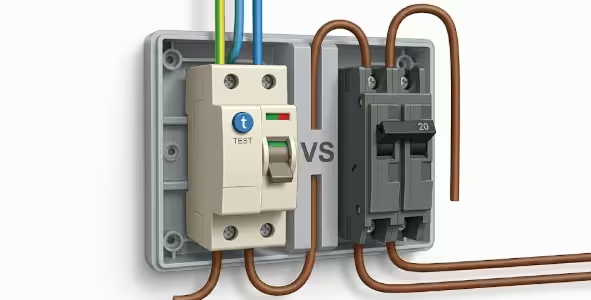
One more, and it’s the one that derails installation day. A ducted system or a set of multi-split heads draws more current than the single wall unit coming out. Sometimes a lot more, and on a full ducted install in an older home that’s occasionally the point where three-phase power enters the conversation. Circuit capacity and switchboard headroom under AS/NZS 3000 want checking before the unit’s ordered, not once it’s sitting in the driveway.
Before You Buy
The maths above gets most Canberra homes into the right bracket. It can’t see your glazing, your insulation, or whether the switchboard has room for the load. That part needs someone standing in the house.
If you’re weighing up a new system, get the switchboard looked at before the unit’s ordered rather than on the day it turns up.