
Electrical fault finding is the process of working out why a circuit failed, not resetting it and hoping the problem stays away. In Canberra, the jobs that come back a second time almost always started the same way. Someone reset the breaker, closed the job, and left before anyone worked out why it tripped.
What Is Electrical Fault Finding?
Fault finding is diagnosis, not repair. An electrician isolates circuits one at a time, tests each for insulation breakdown, earth leakage, and loose connections, and narrows the problem down to a single cable, appliance, or termination before anything gets fixed. A repair callout without that step is a guess dressed up as a solution, and it’s the least glamorous part of the job, but also the part that separates a fix from a proper fix.
Is It a Power Outage, or a Fault in Your House?
Before anything gets tested, it’s worth ruling out the obvious. If the street is dark too, this isn’t fault finding; it’s Evoenergy, and no amount of switchboard troubleshooting will bring the power back. Check whether neighbouring houses still have lights on. If they don’t, the outage is on the network side, and the fix is a phone call, not a callout.
“No power in my house, but the street’s fine” is a different problem. That pattern usually means the fault sits inside the property rather than out on the network, and if it’s confined to your switchboard, you’re dealing with an electrical fault, not a blackout.
Look at the main switch next. A tripped main is often worth treating as emergency electrical territory, usually because it’s a fault serious enough to pull the whole board down. A single tripped circuit breaker is a different story. One circuit has a fault. Everything else in the house keeps running. That’s an electrician’s job, not the network’s, and it’s worth calling one before the fault has a chance to spread.
Most people call an electrician when the real issue is a network outage, and pay for the privilege of being told to ring Evoenergy instead. Checking with a neighbour first saves that conversation.
How Do Electricians Find Electrical Faults?
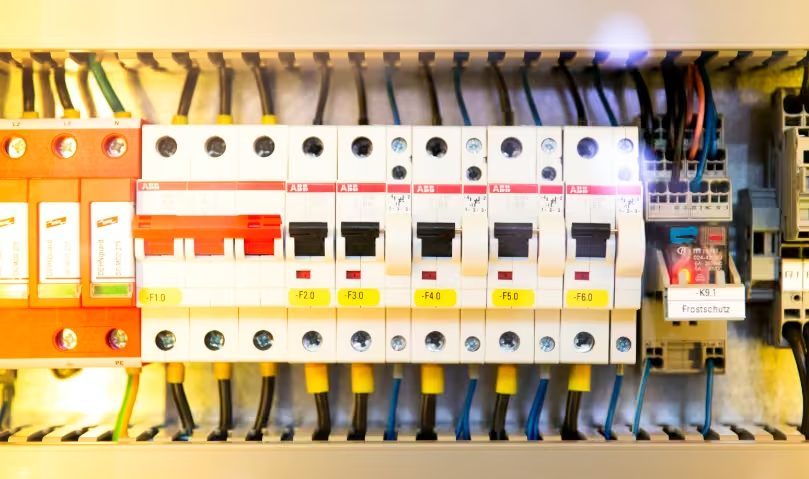
From the homeowner’s side, it looks less like troubleshooting and more like elimination. The electrician will ask what was running when the power went, because a fault that shows up under load points somewhere different to one that appears with nothing switched on. Circuits get isolated one at a time at the switchboard, each tested in turn, until the faulty one stands alone.
Insulation and continuity testing usually come next, run against the isolated circuit rather than the whole board, because testing everything at once just confirms the house has a fault, not where it is. Depending on what turns up, that stage can take twenty minutes or considerably longer. An intermittent fault that isn’t presenting on the day is the slow version of this job, and it’s worth knowing that going in.
The electrician wants to know what was plugged in, when it happened, and whether it’s happened before. Not for small talk. That’s how an electrical fault gets narrowed down from six possible components to one.
How do electricians find electrical faults when nothing about the wiring looks obviously wrong? The network gets ruled out first, at the switchboard, before anything else is tested. What’s left gets tested circuit by circuit, in whatever order the symptoms point to.
What Electricians Actually Check
That’s what electrical fault testing actually looks like in practice: not a single tool, but a sequence of checks that rule things out one at a time. Insulation resistance testing checks cable insulation for breakdown, and degraded insulation lets current leak where it shouldn’t, which is often the fault itself. RCD trip-time and ramp testing goes further than the test button on the front of the switch: a safety switch can look fine and still fail to trip within the required time under an actual fault current, and the button only proves the mechanism moves, not that it moves fast enough.
Earth loop impedance testing checks that a fault current has a low-resistance path back to the source, which is what makes a safety switch trip in the first place rather than sitting there energised. Polarity and connection checks catch wiring that’s technically live but incorrectly terminated. Thermal imaging across switchboard terminations picks up heat building at a loose connection before it turns into one of the warning signs of an electrical fire, which is less about fault finding and more about catching a fault before it happens. Arc fault detection is worth asking about too, particularly on older circuits, though it’s a separate conversation to electrical fault testing itself.
Here’s the part most competitors won’t say: a safety switch that looks like it’s working is not the same as a safety switch that’s been tested. The button on the front proves the switch can move. It doesn’t prove it trips fast enough to matter.
Common Electrical Faults and What They Look Like
Most of these are common electrical problems in Canberra homes that start small enough to miss, which is exactly why an early electrical fault rarely announces itself the way people expect.
| Fault type | What you notice | What it usually means |
| Overloaded circuit | Breaker trips under load, warm powerpoints | Too much drawn from one circuit |
| Degraded wiring | Intermittent trips, faint burning smell | Insulation breakdown, often age-related |
| Earth fault | RCD trips repeatedly, appliance feels “live” | Current leaking to earth somewhere in the circuit |
| Faulty appliance | Trips only when one device is running | The appliance, not the house wiring |
| Loose or heat-damaged termination | Flickering, warm switchboard, buzzing | Connection resistance building into heat |
| Moisture ingress | Trips worsen in wet weather | Water reaching a connection or cable run |
What’s sometimes called an electrical ground fault is the same mechanism described a different way: current finding a path to earth it shouldn’t have, usually through damaged insulation or a compromised appliance. This section stays at symptom level deliberately. Each of these deserves its own explanation, and cramming that in here would turn a table into an essay.
Why Power Tripping Keeps Coming Back
Resetting a breaker once is reasonable. Resetting the same breaker twice, especially if your circuit breaker keeps tripping on a pattern, is a decision to ignore information the circuit is trying to give you.
Power tripping that comes and goes is usually one of four things: an intermittent fault that only shows up under load or in wet weather, moisture reaching an outdoor circuit that’s fine on dry days and fails after rain, a fault that’s actually split across two circuits so isolating one appears to fix it while the other keeps tripping on its own schedule, or an appliance that only leaks enough current to trip the safety switch once it’s been running long enough to heat up. Each of those explains why the same power tripping problem can pass a five-minute inspection and come straight back a week later.
Electrical Fault Finding Canberra: What Older Homes Get Wrong
Ex-government housing from the 1960s and 70s is still common across Canberra’s inner suburbs, and a lot of it is still running original rewirable ceramic fuses rather than circuit breakers. Fuses like that don’t fail cleanly. They degrade, they get rewired with the wrong gauge wire by someone years ago trying to stop them blowing, and they mask exactly the kind of electrical fault a modern breaker would catch immediately.
Homes built before 2000 are the other pattern worth knowing. Many have RCD protection on some circuits and none on others, usually because the safety switch was added to whichever circuit failed an inspection at the time rather than the whole board being upgraded together. That’s not a preference issue. Under AS/NZS 3000, and under the licensing requirements that apply to any electrical work carried out in the ACT, a board showing these switchboard upgrade signs is overdue, not optional.
Roof space temperature swings do more damage here than in the coastal capitals. Canberra’s ceiling cavities run hotter in summer and colder in winter, and that cycling accelerates insulation breakdown in cable that’s already thirty or forty years old. Ceiling spaces disturbed by insulation top-ups are worth checking too; cable run decades ago wasn’t installed expecting someone to be crawling across it later.
Domestic electrical fault finding in a house this age is rarely a single fix. It’s closer to triage, prioritising what’s dangerous now over what’s merely old. Strip “Canberra” out of this section and it should stop describing any house in the country. A 1970s ex-government home with ceramic fuses and partial RCD coverage is a Canberra problem specifically, not a generic old-house problem.
What to Do Before the Electrician Arrives
Every competitor guide ends the reader’s involvement at “call a professional.” There’s more you can usefully do first. Note which circuits are affected and whether the trip happens immediately or only after a while. Think back to what was running when it happened, and whether the fault gets worse in wet weather. If you can, unplug appliances on the affected circuit before testing starts rather than during it.
None of that replaces fault finding; it shortens it. An electrician who knows the pattern before they arrive spends less time reproducing it and more time fixing it, which is worth saying plainly rather than leaving implied.
One limit, stated clearly: reset the main switch once, and stop there. Nothing behind the switchboard cover belongs to anyone without a licence.
When Fault Finding Turns Into Repair Work
Some faults are a same-visit fix: a damaged appliance unplugged, a loose termination re-torqued, a single degraded cable section replaced. Others turn into scheduled work, usually because of access, because the fault is intermittent and needs to be caught rather than assumed, or because isolating it means isolating several circuits at once. A diagnosis that ends in a recommendation rather than an immediate fix is still doing its job. Electrical faults and repairs aren’t always the same visit, and that’s fine.
Whether the outcome is a same-visit fix or scheduled work, our electrical fault finding services and any electrical repairs that follow are quoted separately, so you’re never paying to diagnose a job you’re also paying blind to fix.
If your power keeps tripping or something at the switchboard doesn’t add up, get in touch with Watts Needed to book electrical fault finding Canberra-wide. If the diagnosis is already done and you just need the fix, ask about electrical fault repair instead.
FAQs
How long does fault finding actually take?
Anywhere from twenty minutes to a full visit, depending on whether the fault is present when the electrician arrives. A fault that’s easy to reproduce gets found quickly. An intermittent one that only shows up in the evening or after rain can take longer, simply because it has to be caught in the act.
Can I fix it myself?
In most cases, no. Basic electrical fault testing needs calibrated equipment most homeowners don’t own, and a live switchboard isn’t somewhere to learn on the job. You can reset a tripped breaker once. Past that, it belongs to a licensed electrician. A wrong guess at a live switchboard doesn’t just trip the breaker again. It can hurt someone.
Why does my safety switch keep tripping?
Usually one of the causes covered above: an intermittent fault, moisture in an outdoor circuit, a fault split across two circuits, or an appliance that only leaks current once it’s warmed up. A safety switch that trips repeatedly is doing its job. It’s telling you something specific, not malfunctioning.
Are electrical faults more common in older homes?
Yes, and Canberra’s mix of ex-government housing and pre-2000 builds makes this more relevant here than in newer suburbs. Ceramic fuses, partial RCD coverage, and decades-old cable that’s been through more temperature cycling than it was ever rated for all raise the odds.
What happens if the fault can't be found on the first visit?
It happens more than people expect, particularly with intermittent faults that won’t present on demand. Our electrical fault finding services include a follow-up visit at no extra diagnostic charge until the fault turns up. That’s a more honest answer than pretending every fault resolves in one visit.