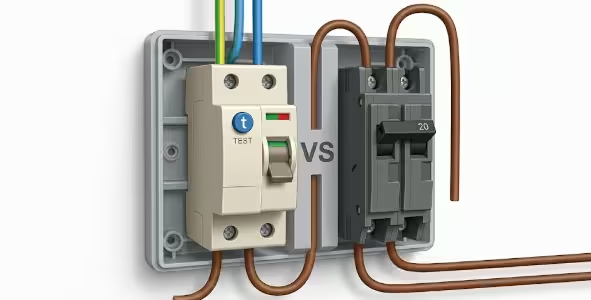
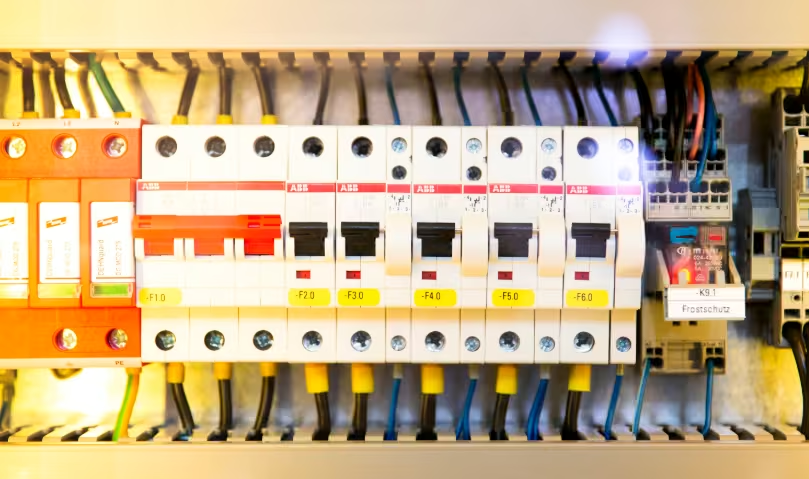
You need to upgrade your switchboard if it still runs rewireable ceramic fuses, has no RCD protection on the circuits you use daily, or has no capacity left for the load you want to add. Age on its own doesn’t force the job. Capacity and compliance do, and those two things decide nearly every quote we write in Canberra.
The question rarely arrives on its own. Someone has a ducted system booked in, or an EV arriving in six weeks, or a bathroom about to be gutted, and the electrician says the board has to come out first. That’s when people start asking whether they really need to upgrade their switchboard or whether they’re being upsold.
Fair question. Here’s how to tell.
Key takeaways
- Ceramic fuses and no safety switches mean replacement, not repair.
- Adding or altering a circuit pulls the board into current AS/NZS 3000 requirements. That’s why upgrades appear on quotes you never asked for.
- Most Canberra homes run single phase with a 63 amp main switch, and most ducted air conditioning fits comfortably inside that.
- Spare slots in the enclosure prove nothing about whether you have capacity.
- A switchboard upgrade and a house rewire are two different jobs.
What is a switchboard upgrade, actually covering?
A switchboard upgrade can mean anything from swapping a few protective devices to replacing the enclosure, the busbar, the earthing arrangement and the consumer mains feeding it. Same two words, wildly different jobs.
At the small end, an electrician might fit RCBOs to a handful of circuits in a board that’s otherwise sound and has room. Half a day, no distributor involvement.
The full version is the one people picture without realising it. Old enclosure off the wall, new one on, every circuit re-terminated and identified, main switch sized to the supply, RCD protection across final sub-circuits, and a Certificate of Electrical Safety submitted to Access Canberra afterwards. If the board was mounted on asbestos sheeting, which turns up regularly in Canberra stock built before 1990, that becomes a separate controlled removal on the same day. If the consumer mains are undersized or aluminium, they get replaced too, and Evoenergy has to be in the loop for the disconnection and reconnection.
Most homeowners sign a quote without knowing which of those they’ve bought.
Ask for the scope in writing before you agree. Specifically: what’s being replaced, what’s being reused, and whether the mains and the meter enclosure are in or out.
Why do I need a switchboard upgrade when nothing seems wrong?
Because the moment you add or modify a circuit, that work has to comply with AS/NZS 3000 as it reads now, not as it read in 1974. New sub-circuits need RCD protection. RCDs have been required on final sub-circuits in new ACT dwellings since mid-2018, and rental properties carry their own obligations.
An old fuse board can’t provide that. So the aircon circuit you wanted brings the board with it.
There’s a second trigger that has nothing to do with rules. Ceramic fuse carriers and 40-year-old bakelite hold heat, loosen at the terminals, and char quietly behind the cover. We open boards in Canberra where the neutral bar has discoloured, and nobody in the house had any idea.
The question worth asking your electrician is a simple one: what exactly is non-compliant here, and how are you proposing to fix it? A licensed electrician will name the clause, point at the component, and tell you what the remedy is. That answer separates a real assessment from a template quote, and it keeps you on the right side of the line without ever touching the board yourself.
Is a switchboard upgrade the same as rewiring the house?
No. They’re separate jobs with separate scopes, and conflating them is one of the fastest ways to be quoted for work you don’t need.
The switchboard distributes and protects. The wiring is everything behind the plaster: the cabling, the outlets, the light points, the earthing. A new board can absolutely reveal a wiring problem, because RCDs are unforgiving of insulation that’s gone brittle and started leaking to earth. That’s a finding, not the same job. A good electrician will tell you which one you’re facing rather than rolling them together.
Does a 1970s house need rewiring?
Not automatically, and plenty of Canberra homes from that era are still running perfectly serviceable TPS cabling. What matters is the insulation type, the earthing arrangement, and whether the sub-mains are aluminium, which was common through the 60s and 70s and is worth replacing on site.
The tell is behaviour, not the calendar. Circuits that trip as soon as an RCD goes in, warm outlets, or lights that dim hard when the kettle goes on.
Do you need 3-phase power for air conditioning?
For most homes, no. Split systems and ducted units up to roughly 14 to 15kW of cooling capacity generally run on single phase without any trouble. Three phase becomes necessary when the manufacturer’s nameplate says so, when the system sits above that band, or when the rest of the house is already drawing hard.
Some numbers to ground it. A typical split system sits on a dedicated 10 to 16 amp circuit. A 10kW ducted unit pulls somewhere around 18 to 22 amps at full tilt on single phase. A standard Canberra home with a 63 amp main switch has roughly 15kW of total household capacity to play with, and that ceiling is the real constraint, not the air conditioner in isolation.
So the honest answer to “can AC run on single phase” is yes, almost always, and we talk people out of three-phase conversions more often than into them. Converting is a supply job, not a switchboard job. New mains, distributor involvement, and a wait.
Where it does stack up: a large two-storey home running a big ducted system, induction cooking, a heat pump hot water unit and an EV charger. Load them all onto one phase, and you’ll find the limit. Spread across three, and each phase barely notices. Fujitsu, Daikin and ActronAir all publish the electrical requirements for their ducted range, and that spec sheet answers the question faster than any general rule.
Worth knowing if solar is on your list too: Evoenergy allows a larger inverter and battery rating on three-phase sites than single-phase, which changes the maths for anyone planning a battery later.
If you’re weighing systems, the ducted and split system wiring gets specified alongside the board assessment, not after it.
Spare space on the board isn’t the test
If there’s a gap next to the existing breakers, that doesn’t mean you have room in any meaningful sense. It means there’s a gap.
Capacity is determined by the rating of the main switch, the size of the consumer mains feeding it, and the rating of the enclosure itself. An electrician does a maximum demand calculation under AS/NZS 3000 to work out whether the new load fits. Physical space is the last thing on that list, not the first.
Plenty of boards have four free poles and no capacity at all.
Does it change if I’m in an apartment rather than a house?
Yes, and this is where Canberra unit owners in Braddon, Kingston and Woden hit walls that freestanding homeowners never see.
Apartments are typically fed from a common meter room, with each unit allocated a single phase off a three-phase building supply. Your capacity was decided when the building was designed, and it’s usually tight. The board inside your unit is a sub-board, not a main switchboard, so upgrading it doesn’t give you more supply. It just redistributes what you’ve already got.
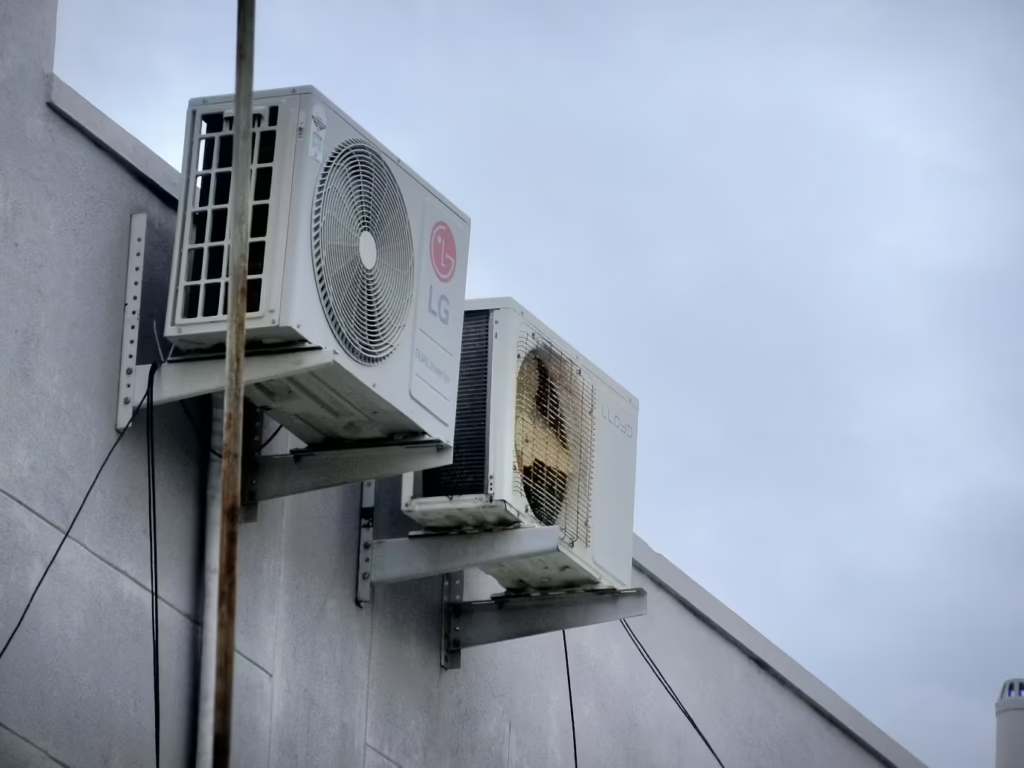
Adding a genuine load, an EV charger being the obvious one, means going back to the owners corporation, because the cabling runs through common property and the building’s total capacity is a shared resource. Some buildings have headroom. Some were maxed out on handover. Balcony condenser placement carries its own approval process on top of the electrical side.
None of that makes the work impossible. It makes the sequence different: building approval first, electrical design second. Houses run the other way around.
What to sort out before the electrician arrives
Plan for a day without power. This gets left out of almost every article on the subject, and it’s the thing that catches people. Supply comes off for a full board replacement, often for most of the working day. Run the fridge and freezer down beforehand, move anything you can’t lose into an esky, charge laptops and phones the night before, and don’t book the job on the day you’re hosting.
Then bundle the visit.
Attendance and setup are a meaningful share of what a job costs, and the board is already out. If a bathroom renovation is coming, get those circuits run now. Extra power points, downlights, a dedicated circuit for the shed, an outdoor point that’s been on the list for three years. All far cheaper on a day the board is already open than as a separate callout later.
And size the enclosure for what’s coming, not what’s there. Solar, a battery, an EV charger, energy monitoring. Every one of those wants a home on the board, and the difference between a board with room and a board without it is small at installation and expensive to fix twice. We’ve replaced boards that were only four years old because somebody bought exactly what they needed on the day.
If your board still has fuses, or you’ve been told an upgrade is needed before an aircon or EV charger install, the sensible next step is having someone look at it properly and tell you which job you’re facing. Nathan and the team have been doing switchboard and supply work across Canberra and Queanbeyan for years, and an inspection will give you a scope you can actually compare.