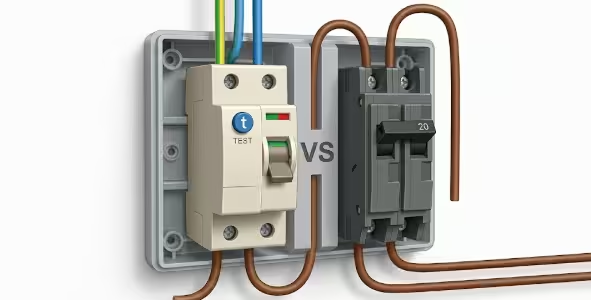
Safety switch vs. circuit breaker comes down to what each device is watching. A circuit breaker watches the cable and trips before the wiring overheats. A fuse does the same job with a thin wire that melts. A safety switch watches for current leaking out of the circuit, usually through a person or through water, and cuts the power in a fraction of a second.
Only one of the three is there for you.
Around four in ten Australian homes have no safety switch at all. Plenty of them are in Canberra’s older suburbs, on original boards that still run ceramic fuses, or on boards where someone added a single safety switch for the power points years ago and left the lights uncovered.
What is a fuse?
A fuse is a weak link put there on purpose. Current runs through a short length of wire sized for the circuit, and when the load climbs past what that wire can carry, it melts, and the circuit goes dead. There’s nothing to reset. The blown fuse gets rewired or replaced.
In an older fuse box you’ll see a row of white ceramic carriers that pull straight out of their bases, each with fuse wire running between two small screws. The design is simple, and it works. The weak point is what happens after a fuse blows at 9 pm with no spare fuse wire in the house. Whatever turns up in the kitchen drawer goes in its place: a heavier gauge of wire, a strand stripped off an old extension lead, the odd paperclip. Power comes back and stays back. That oversized wire will now carry several times the current the cable behind the wall is rated for, so the circuit has quietly lost its overload protection, and from the front the board looks the same as it did the day before. On older Canberra boards, wrong-gauge fuse wire is a regular find.
If your fuse box still has a ceramic fuse in every slot, that alone is one of the clearer signs the board is due for a switchboard upgrade.
What is a circuit breaker?
A circuit breaker does the fuse’s job with a mechanism. Inside sits a bimetal strip that bends as it heats under a sustained overload, plus a magnetic coil that snaps the contacts open the instant a short circuit hits. The handle drops and the circuit goes off. Once the cause is dealt with, you push it back up.
Each breaker is sized to the cable it feeds, typically 16 or 20 amps for power circuits in a house. Its job is to stop that cable cooking inside the wall. Shock protection was never part of the design. Around 50 milliamps through the chest can stop a heart, and a 20-amp breaker will carry that all day without moving.
Circuit breaker vs fuse: is a breaker safer?
On cable protection, circuit breaker vs fuse is close to a draw. Both cut the circuit on overload and short circuit. The breaker’s one clear advantage is that nobody can up-rate it with fuse wire from the drawer.
The quick reset changes how people behave, though. The handiest thing about a breaker is also the problem with it. A blown fuse forces a pause while someone hunts for a torch and the right wire, and that pause tends to make people wonder why it went. A breaker takes two seconds. So people stand at the board flicking it back on, sometimes three or four times in an evening, without asking what tripped it.
A new set of breakers won’t fix whatever was blowing the fuses, either. A healthy circuit shouldn’t be blowing or tripping at all.
Not sure whether you’ve got a fuse or circuit breaker on each circuit? Fuses sit in removable carriers, usually ceramic. Breakers are narrow modules with a toggle, clipped side by side onto a rail.
What is a safety switch?
A safety switch, also called an RCD (residual current device), compares the current going out on the active wire with the current coming back on the neutral. On a healthy circuit, the two match. When they don’t, some of that current has found another way to earth, and the path it found is often a person.
A domestic RCD safety switch trips at 30 milliamps of leakage, usually inside 30 milliseconds. Fast enough to stop a shock before it upsets the heart’s rhythm. And none of it depends on an overload: a drill bit through a cable, a cracked kettle cord, rainwater sitting in an outdoor power point. The current on the circuit stays small, and the breaker never notices.
About fifteen people a year die from electric shock in Australian homes. Hospital admissions run into the hundreds. Electrical safety bodies have argued for decades that a working safety switch would have prevented most of those.
In the ACT, any new circuit or alteration has to meet AS/NZS 3000, which now calls for RCD protection on every final sub-circuit in a home. Nothing forces an owner-occupier to retrofit an existing board, so a lot of older houses go without until someone books a switchboard upgrade.
Safety switch vs circuit breaker
Fuse | Circuit Breaker | Safety Switch (RCD) | RCBO | |
Protects | The cable | The cable | People | Cable and people |
Trips on | Overload, short circuit | Overload, short circuit | Current leaking to earth | Any of those |
After a trip | Rewire or replace the fuse | Push the handle back up | Reset once the leak is found | Reset once the cause is found |
Test button | No | No | Yes | Yes |
The quickest way to see the difference between RCD and circuit breaker devices on your own board is that test button. Count them. If none of the modules has one, nothing on the board is protecting people.
Where does an RCBO fit in?
An RCBO circuit breaker is an RCD and circuit breaker built into one module, so each circuit carries its own overload and leakage protection. It settles the RCD vs circuit breaker choice by not making you pick.
Where it earns its place is when something goes wrong. On an older-style board, one safety switch might cover half the house. An oven element starts leaking to earth as it ages, the switch trips, and every light and power point on that side goes down with it. You end up resetting in the dark with no idea which circuit caused it. Put an RCBO on each circuit, and the oven goes off on its own, which is why a modern switchboard upgrade will often use them throughout.
What does it mean when a safety switch keeps tripping?
One trip with an obvious cause isn’t a worry. Too many appliances on one circuit is something you can sort out yourself. Switch a few things off and reset it. If it trips again with the load off, stop resetting it and get an electrician in.
In Canberra, look at moisture first. Outdoor power points and garden lights take in water over winter; frost and condensation work into seals that looked fine in March, and the switch drops out on a cold morning for no reason anyone inside can see. An ageing oven and hot water elements account for plenty of the rest.
To narrow it down, unplug everything on the affected circuit and reset. If it holds, plug things back in one at a time until one of them trips it. That appliance is your fault. If it trips with everything unplugged, the problem is in the fixed wiring or something hard-wired, and the next step is proper fault-finding with an insulation resistance tester.
Check which device dropped before you call, because RCD vs circuit breaker tells an electrician what kind of fault to hunt for.
And never have a tripping safety switch bypassed or swapped for something less sensitive. The leak would still be there, with nothing left watching it.
How often should you test a safety switch?
Every three months. Press the test button on each one, and it should snap off straight away, killing the circuits it covers. Push it back up, and you’re done. If nothing happens, call an electrician.
A fuse has nothing to seize. A breaker or safety switch is a mechanism, and mechanisms stick when they sit untouched for years. All the handle tells you is its position. It says nothing about whether the parts inside will move when they need to, and a switch that has sat in the on position since the house last changed hands looks the same as one that works.
Most of the safety switch testing Canberra households do is that quarterly press of a button, which is the right habit to have. An electrician’s test adds what the button can’t: a dedicated RCD tester measures the trip current and trip time, so it picks up a switch that still trips but has drifted slow. Book one when you buy an older home or take on a rental.
Not sure what’s on your board?
If your board still runs ceramic fuses, or a safety switch keeps dropping out and you’d like the cause found, book a Watts Needed electrician or call 0440 138 246. We’re based in Googgong, we work across Canberra, and we’ll test every safety switch on the board before we quote on anything.
FAQs
Can I replace ceramic fuses with circuit breakers myself?
No. Switchboard work in the ACT is licensed work. Plug-in breakers that fit old fuse bases do exist, but they only handle overload, and a board old enough to need them is usually due for a proper replacement with RCD protection.
How many safety switches does a house need?
Current wiring rules want RCD protection on every final sub-circuit. That can mean a few RCDs each sharing several circuits, or an RCBO on every circuit. One per circuit is the better setup, for the oven-in-the-dark reason above.
Is a safety switch the same as a surge protector?
No. A surge protector deals with voltage spikes from lightning and network faults.
Will a safety switch trip if I touch active and neutral at the same time?
Not necessarily, and that surprises people. If current flows in through one conductor and back out through the other with none of it reaching earth, the RCD sees a balanced circuit and stays on. In a house that’s rare, since bare feet on tiles or a hand on a tap gives the current an earth path and the switch trips. Electricians still isolate a circuit at the board before touching anything, and this is the reason.